Learn how mid-market companies can accurately define their Ideal Customer Profile to boost revenue and avoid costly mistakes in targeting.
The difference between mid-market companies that scale efficiently and those that burn cash chasing bad-fit customers often comes down to a single strategic asset: the Ideal Customer Profile.
Most mid-market companies get their ICP wrong, not because they lack the data, but because they define it using the wrong inputs. They describe markets instead of buyers. They rely on assumptions instead of evidence. They treat the ICP as a static document rather than a living operational tool.
The cost of these mistakes is substantial but often invisible. As one CMO discovered, 80% of his pipeline came from just 20% of his customers, a classic Pareto distribution that revealed how much effort was wasted on accounts that would never become high-value relationships. forbes.com That's not a rounding error; it's thousands or millions in pipeline revenue dollars and EBITDA sitting just outside your focus, invisible because no one questioned the original assumptions.
This guide walks through how mid-market companies can look at their existing client data to define ICPs that actually work, the common mistakes that quietly sabotage revenue, and a practical playbook for getting it right.
What an ICP Is (And What It Isn't)
An Ideal Customer Profile defines the type of company that would most benefit from your products or services, and therefore represents your most valuable potential customer. netsuite.com But that definition misses a critical dimension: the ICP should also identify customers who return the highest lifetime value with the least friction.
Your Total Addressable Market (TAM) measures everyone you could serve. Your ICP defines who you should serve. TAM is market size. ICP is focus and execution. Conflating the two is the first mistake many companies make, and it cascades through every go-to-market decision that follows.
A strong ICP goes beyond firmographics (company size, industry, geography) to include behavioral signals, internal triggers, decision dynamics, and organizational readiness for change. McKinsey's research on customer identification emphasizes that effective profiling must capture behaviors, preferences, and expectations, not just demographic categories. mckinsey.com When a founding team tells an investor they're targeting "mid-size companies in financial services," they've described a market, not a buyer. That distinction matters more than most realize.
Mining Your Client Data: A Practical Framework
The most reliable source for defining your ICP isn't industry reports or competitor analysis. It's your own customer database. Your existing clients contain patterns that reveal who buys well, who doesn't, and why.
Here's how to extract those patterns:
Step 1: Segment by Customer Quality, Not Just Revenue
Start by categorizing your current and past clients into three tiers:
- High-quality customers: Fast sales cycles, strong retention, expanded over time, low support burden, willing to provide referrals
- Acceptable customers: Closed eventually, retained adequately, required significant effort but delivered acceptable returns
- Problem customers: Long sales cycles, high churn, heavy support requirements, discounted deals, scope creep, or outright failures
Most companies instinctively rank customers by revenue. That's a mistake. A $500K customer who required 18 months to close, churned after one year, and consumed disproportionate support resources may have been net-negative for the business. A $150K customer who closed in six weeks, renewed three times, and referred two other clients generated far more value.
Step 2: Identify Structural Patterns in Your Best Customers
Once you've segmented by quality, examine your high-quality tier for structural similarities. Look beyond the obvious firmographics:
- Internal triggers: What event or pressure created urgency? Was it a regulatory change, a new executive hire, a competitive threat, a failed initiative with a previous vendor?
- Decision dynamics: How did decisions get made? Was there executive sponsorship? A single champion? A buying committee?
- Technology environment: What systems were already in place? Zendesk notes that strong ICPs often include factors like most-used software, recognizing that technology compatibility predicts implementation success. zendesk.com
- Organizational readiness: Did they have internal resources to support adoption? Companies with dedicated project owners tend to onboard faster and retain longer.
A Veritac Group client in the logistics technology space initially defined their ICP by company size and geography. When we analyzed their customer base, we discovered that their fastest-closing, highest-retention accounts shared an unexpected characteristic: they all had experienced a failed implementation with a competitor within the prior 18 months. That "failure trigger" predicted buying intent better than any demographic filter, but it was invisible in their original ICP.
Step 3: Analyze Your Problem Customers With Equal Rigor
The pattern recognition works in reverse as well. Your churned customers, stalled deals, and support nightmares contain signals about who you should avoid.
Common patterns in problem accounts often include:
- Lack of executive sponsorship at purchase
- Purchased primarily on price rather than fit
- Misaligned expectations about implementation timeline or required resources
- No clear internal owner for the relationship post-sale
One manufacturing client discovered that nearly all their churned accounts had been "sold down," the initial champion left the company within the first year, and no executive sponsor remained to protect the relationship. That insight changed their qualification criteria: they began requiring confirmed executive sponsorship before advancing opportunities past a certain stage.
Step 4: Test for Consistency Across Your Sales Team
Different salespeople often have different intuitions about what makes a good customer. Those intuitions are valuable, but they need to be tested against data.
Interview your top performers about the deals they're most proud of; not the biggest deals, but the ones that felt right. Ask what those accounts had in common. Then compare their answers to what the data actually shows.
Often, you'll find that salespeople have identified real patterns but described them imprecisely. One might say, "they got it immediately." When you dig deeper, what they mean is that the buyer had experienced a specific pain point and recognized the solution without extensive education. That's a measurable characteristic you can filter for in targeting.
The Five ICP Mistakes That Cost Mid-Market Companies the Most
Defining an ICP correctly is difficult. Defining one incorrectly is remarkably easy. These are the mistakes we see most often:
Mistake 1: Treating Every Prospect as Equally Likely to Buy
Companies without a defined ICP essentially treat every potential customer in a market as if they were equally likely to purchase their products or services. This approach leads to unfocused marketing campaigns that produce few qualified leads and even fewer completed sales. netsuite.com
The solution isn't to narrow your market arbitrarily; it's to let customer quality data guide your focus. Start wider than you would expect during initial analysis, then let conversion behavior and retention patterns narrow your targeting.
Mistake 2: Stopping at Firmographics When Behavior Matters More
Two companies can appear identical in firmographics, same industry, same headcount, same geography, and behave completely differently as customers.
McKinsey's research emphasizes that customer identification must go beyond demographics to include psychographics (behaviors, preferences, and expectations) mckinsey.com. A company facing a regulatory deadline behaves differently from one exploring options casually. A company that just lost a key vendor behaves differently than one with an incumbent they're satisfied with.
The behavioral layer is where predictive power lives. Firmographics tell you who could buy. Behaviors tell you who will buy.
Mistake 3: Defining ICP Once and Never Revising It
An ICP is not a strategic planning artifact that gets filed after the annual offsite. Markets shift. Products evolve. Customer success patterns change.
Companies that treat ICP definition as a one-time exercise find themselves pursuing yesterday's ideal customer while today's best-fit buyers go unrecognized. The discipline of quarterly ICP review, examining recent wins, losses, and churn against your stated profile, is what separates companies that scale efficiently from those that don't.
Mistake 4: Building ICP in Isolation from Sales and Customer Success
Marketing often owns ICP definition. That's fine for coordination purposes, but the inputs must come from across the revenue organization with critical input from Sales, and Customer Success.
Sales knows which deals felt easy and which felt like pushing a boulder uphill. Customer Success knows which accounts require constant intervention and which run smoothly. Product knows which customers provide feedback that shapes the roadmap versus which request features that would distort it.
Forbes emphasizes that your ICP should be clearly documented so that sales, marketing, and customer service teams have a consistent definition of the ideal customer. forbes.com An ICP built without cross-functional input is a hypothesis. An ICP built with it is an operational tool.
Mistake 5: Confusing "Customers We Have" with "Customers We Want"
Your existing customer base may not represent your ideal customer. Early customers often came through opportunistic channels, founder relationships, investor introductions, inbound inquiries from companies that found you before you found them.
The goal of ICP analysis is not to describe who you've sold to. It's to identify who you should be selling to. Those are different questions, and conflating them is how companies accidentally institutionalize their early mistakes.
How to Diagnose a Broken ICP
The symptoms of a misaligned ICP are often attributed to other causes: weak messaging, insufficient pipeline, poor sales execution. Frequently, the root problem is that you're talking to the wrong people.
Here are the diagnostic signals that suggest your ICP needs revision:
Long and unpredictable sales cycles. If deals take dramatically longer than expected, or if cycle length varies wildly with no clear explanation, you may be pursuing accounts that lack urgency or internal alignment.
High churn concentrated in specific segments. Examine your churn by customer characteristic. If certain industries, company sizes, or acquisition channels churn at significantly higher rates, those segments may not belong in your ICP regardless of how attractive they appear on paper.
Excessive discounting to close deals. Consistent price pressure often indicates poor fit. Customers who see clear value pay closer to full price. Customers who don't require discounts to move forward.
Heavy support burden on specific account types. Some accounts consume disproportionate support resources. If there's a pattern, certain industries, certain company sizes, certain buying processes, that's an ICP signal.
Sales team disagreement on what "good" looks like. If your salespeople can't agree on which accounts are worth pursuing, your ICP isn't specific enough to guide behavior. An ICP should create alignment, not just alignment on who to target, but on who to walk away from.
Marketing generates leads that sales ignores. When there's persistent tension between marketing and sales over lead quality, the ICP is often the hidden cause. Either the ICP is too broad, or it isn't being applied consistently across functions.
What to Do When Your ICP Is Wrong
Recognizing a broken ICP is the first step. Fixing it requires a structured approach:
Pause before pivoting. A broken ICP doesn't mean you need to abandon your current focus entirely. Often, the fix is refinement rather than revolution, adding qualification criteria, removing a segment that underperforms, or reweighting priorities.
Quantify the problem. Before making changes, measure the current state. What's your conversion rate by segment? Your average cycle length? Your churn rate? Your customer acquisition cost? These metrics will tell you which segments are actually underperforming and by how much.
Isolate the problematic segments. Not every part of your ICP is wrong. Identify specifically which characteristics correlate with poor outcomes and focus your revision there.
Test before committing. If you're considering a significant ICP shift, run a controlled test. Allocate a portion of sales capacity to the new target segment and measure results before redeploying the entire team.
Communicate the change clearly. An ICP revision affects marketing targeting, sales prioritization, customer success resource allocation, and potentially product roadmap. Everyone needs to understand not just what changed, but why.
The ICP Validation Playbook: Applying the APRO Framework™
Use this playbook, structured around Veritac Group's APRO Framework™, to validate whether your current ICP is correct or to build one from scratch.
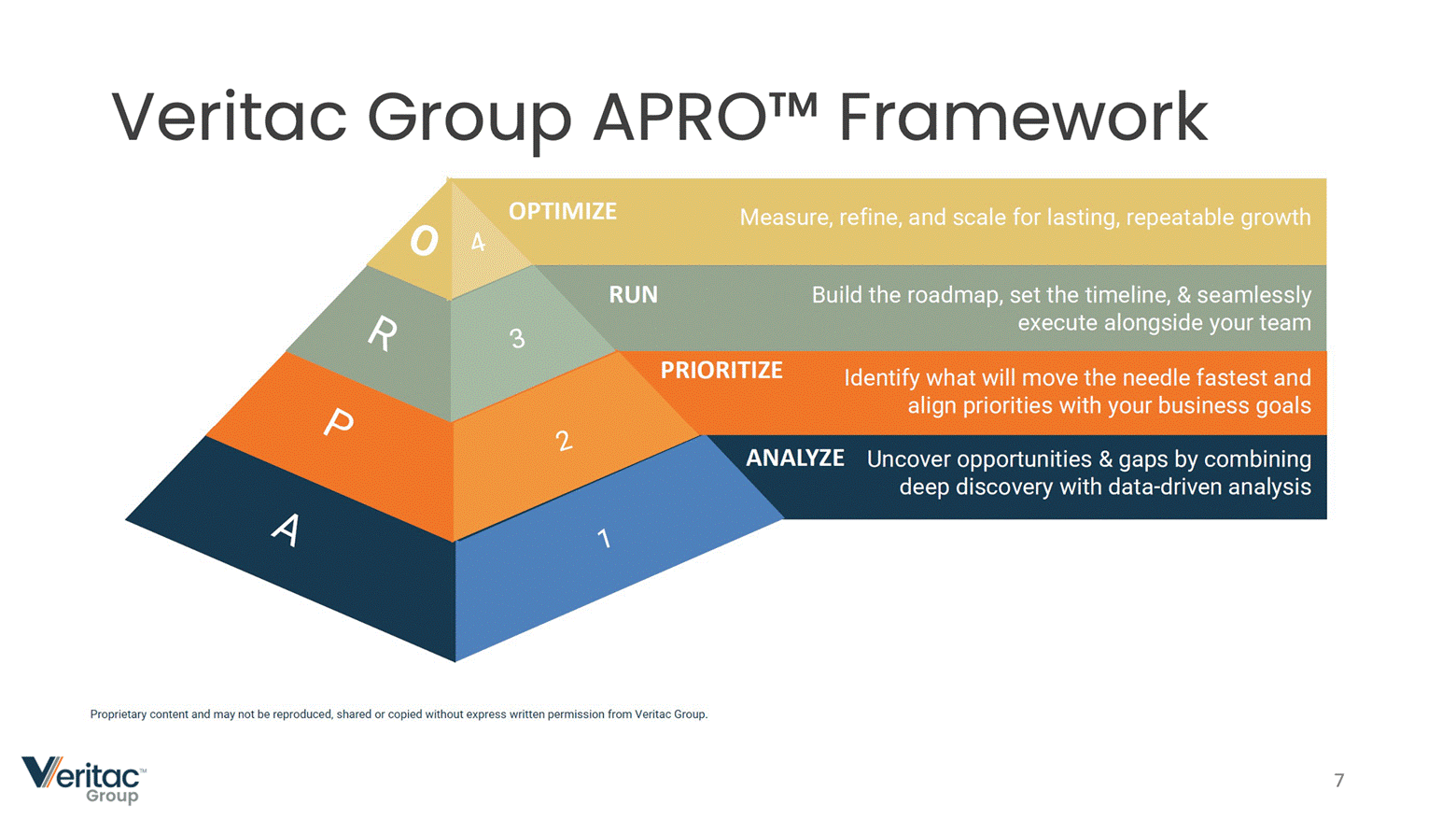
A – Analyze: Uncover Opportunities and Gaps
The foundation of any ICP initiative is rigorous discovery. Before revising or building, you need to understand what the data actually shows.
Customer Segmentation Analysis (Week 1)
- Export your complete customer list with key attributes: industry, size, geography, acquisition channel, deal size, cycle length, retention status
- Categorize each customer as high-quality, acceptable, or problem using the criteria defined earlier in this guide
- Calculate lifetime value, support burden, and expansion revenue for each tier
- Identify which segments are actually profitable versus which consume resources disproportionate to their returns
Qualitative Discovery (Week 2)
- Interview 5-10 customers from each tier about their buying process, what drove urgency, and what they would change about working with you
- Interview sales team members about their best and worst deals, specifically what made them easy or difficult
- Gather customer success data on support ticket volume, NPS scores, and renewal patterns by customer segment
Pattern Recognition (Week 3)
- Identify the 5-7 characteristics most common in high-quality customers
- Identify the 5-7 characteristics most common in problem customers
- Look for "invisible" factors, behavioral triggers, technology indicators, or situational contexts, that predict success but aren't captured in your current ICP
- Document gaps between your stated ICP and where value actually concentrates
P – Prioritize: Identify What Moves the Needle Fastest
Analysis without prioritization creates noise, not clarity. This phase translates findings into a focused, actionable ICP.
Weighting and Scoring (Week 4)
- Rank each identified characteristic by its predictive power, how strongly does it correlate with customer quality?
- Distinguish between "must-have" criteria (characteristics present in nearly all high-quality customers) and "nice-to-have" signals (characteristics that improve probability but aren't essential)
- Define explicit disqualification criteria, characteristics that should remove an account from consideration regardless of other factors
- Create a scoring framework that reflects these weights, enabling consistent application across the revenue organization
Alignment and Trade-offs (Week 4, continued)
- Test the revised ICP against your current pipeline: How many active opportunities would qualify? How many would be disqualified?
- Assess resource implications: Does the new ICP require different marketing channels, sales skills, or customer success capacity?
- Resolve trade-offs explicitly. A tighter ICP improves efficiency but may reduce addressable volume, ensure leadership alignment on the balance
- Document the rationale for each criterion so future revision is grounded in data rather than memory
R – Run: Build the Roadmap and Execute
A validated ICP has no value until it's operationalized. This phase embeds the new profile into daily workflows across marketing, sales, and customer success.
Operational Integration (Weeks 5-6)
- Update marketing targeting, paid media audiences, content strategy, ABM lists, to reflect the revised ICP
- Revise sales qualification criteria and configure CRM fields to capture the necessary data points at each stage
- Align SDR/BDR outbound targeting with the new profile; retire lists that no longer fit
- Brief the entire revenue organization on the changes and the reasoning behind them; clarity on "why" drives adoption
Enablement and Tooling (Weeks 6-7)
- Create a one-page ICP reference document that sales and marketing can use daily
- Build or update lead scoring models to reflect the new criteria
- Establish feedback loops: How will sales flag leads that don't fit? How will marketing receive that signal?
- Set baseline metrics before the new ICP takes full effect, conversion rates, cycle length, win rate by segment, so you can measure impact
O – Optimize: Measure, Refine, and Scale
An ICP is a living asset. The companies that sustain growth treat ICP validation as a continuous discipline, not a one-time project.
Performance Tracking (Ongoing)
- Track conversion rates, cycle length, and retention by ICP segment monthly
- Monitor support burden and expansion revenue to ensure post-sale experience matches pre-sale expectations
- Flag deals that close outside the ICP and analyze whether they represent a missed segment or a one-time exception
- Compare new customer cohorts against historical benchmarks to measure whether ICP changes are producing the intended results
Iteration Cadence (Quarterly)
- Conduct a formal ICP review every quarter with stakeholders from marketing, sales, and customer success
- Examine recent wins, losses, and churn against your stated profile; where did the ICP predict correctly, and where did it miss?
- Adjust criteria when data warrants it; resist changing based on anecdote or a single outlier deal
- Document revisions and communicate changes across the organization to maintain alignment
Scaling What Works (As Evidence Accumulates)
- Double down on channels and segments where the revised ICP produces outsized results
- Reallocate resources away from segments that underperform despite fitting the original profile
- Use ICP insights to inform product roadmap decisions. Features that serve your best customers deserve priority over those that serve marginal segments
- Share ICP learnings with investors and board members as evidence of go-to-market maturity
The APRO Framework™ ensures that ICP definition isn't a theoretical exercise but a structured process that moves from insight to execution to measurable impact. Companies that apply this discipline don't just define their ideal customer; they build the operational infrastructure to find, win, and retain them at scale.
Why This Matters for Investors
For mid-market investors evaluating portfolio companies or acquisition targets, ICP clarity is a proxy for go-to-market maturity. A company that can articulate precisely who their ideal customer is, with data to support the definition, will scale more efficiently than one operating on assumptions.
The questions to ask:
- How was the ICP defined, and when was it last revised?
- What percentage of current customers actually fit the stated ICP?
- How do conversion rates and retention differ between ICP-fit and non-ICP accounts?
- Is the ICP operationalized in marketing, sales, and customer success, or is it a strategy document that sits unused?
The answers reveal whether the company has a real go-to-market engine or just a hypothesis.
The Veritac Group Perspective
Mid-market companies face a particular challenge with ICP definition. They've moved beyond the founder-led sales motion where intuition sufficed, but they often lack the data infrastructure and analytical resources of enterprise organizations.
At Veritac Group, we work with mid-market companies to build ICPs grounded in customer evidence rather than assumption. The methodology outlined here reflects the approach we use with our clients, one that treats ICP not as a marketing exercise but as a core operational asset that shapes every revenue decision.
The companies that get this right don't just grow faster. They grow more efficiently, with shorter sales cycles, higher retention, and clearer prioritization. In a capital environment where efficiency matters as much as growth, that clarity becomes a competitive advantage.
If your sales cycles are longer than they should be, if churn is concentrated in segments you thought were ideal, or if your sales and marketing teams can't agree on what "good" looks like, the ICP is likely the hidden cause. The fix isn't more activity. It's sharper focus on the customers who actually create value for your business.