Unlock growth for your mid-market company by mastering customer signal analysis. Understand your customers better, boost revenue, and outpace competitors.
Most mid-market CEOs know their best customers. They could name them, describe the deal, tell you why it closed. What they cannot do, in most cases, is tell you why the next one will close. That gap, between knowing your best customers and systematically finding more of them, is where growth stalls. Customer signal analysis is how you close it.
There is a version of mid-market growth that runs on relationships, referrals, and institutional memory. It works, up to a point. Then the company hits a ceiling it cannot explain and cannot break through with more of the same. Hire another rep. Run another campaign. Consider a rebrand. None of it moves the number.
The ceiling is almost never a product problem. It is a signal problem. The business does not have a systematic way of reading what its customers and prospects are telling it, when they are telling it, and responding faster than the competition.
Customer signal analysis changes that. Not as a technology project or a data science initiative, but as a commercial discipline that makes every sales and marketing dollar work harder. Here is what the research says, what the models look like, and how a mid-market company selects the right one.
Why the Data Demands Attention
The McKinsey B2B Pulse 2024 is the most compelling anchor point for this conversation. It surveyed commercial leaders across industries and found that data-driven commercial teams that blend personalized customer experiences with AI are 1.7 times more likely to increase market share than those that do not.[1] The same research found that top-performing B2B companies using omnichannel, signal-informed sales strategies achieve up to 70% higher market share growth than peers.[1]
That is not a marginal difference. For a PE-backed company with a 5-year hold period, or a founder-led business trying to hit a growth threshold that justifies a sale, 70% higher market share growth is the difference between a good outcome and a great one.
Gartner's 2025 Enterprise Growth Agenda Survey is equally pointed. It identified a focus on customer needs as a primary driver of growth, and found that executive leaders who invest in voice-of-customer initiatives build a compounding advantage over those who rely on internal assumptions.[2] Separately, Gartner predicted that by 2025, 60% of organizations with voice-of-customer programs would supplement traditional surveys by analyzing voice and text interactions with customers.[3] That prediction has landed. It is now baseline, not differentiation.
Harvard Business Review has tracked the retention angle for years: a 5% increase in customer retention can increase profits by 25% to 95%.[4] For a mid-market company, that is not a customer success metric. It is a valuation metric. The business that reads churn signals early and acts on them is worth more than the one that finds out on renewal day.
1.7x more likely to grow market share — data-driven commercial teams vs. those without (McKinsey B2B Pulse 2024)
70% higher market share growth for B2B companies using signal-informed omnichannel strategies (McKinsey 2024)
25-95% profit increase from a 5% improvement in customer retention (Harvard Business Review)
80% of B2B sales interactions now happen in digital channels — where signal is richest (Gartner)
What Customer Signal Analysis Actually Means
Before selecting a model, it helps to be clear on what customer signal analysis is and is not. It is not a CRM project. It is not a data warehouse initiative. It is the practice of systematically collecting, interpreting, and activating behavioral, transactional, and intent data from current and prospective customers to make better commercial decisions, faster than the competition.
Signals fall into four categories:
Behavioral signals: Website visits, content consumption, product usage patterns, email engagement, event attendance.
Intent signals: Third-party data indicating that a prospect is actively researching a purchase decision, even before they have contacted you.
Transactional signals: Purchase history, contract renewal windows, upsell and cross-sell patterns, churn indicators in usage data.
Voice-of-customer signals: Survey responses, support interactions, NPS scores, review patterns, win/loss interview themes.
Each signal type has different collection methods, different activation paths, and different ROI profiles. The art is combining them into a growth system that marketing and sales run from together, not separately.
"Effective multi-channel marketing is about targeting the right strategic areas, not being everywhere. Customer reviews and behavioral signals create a visible, lasting signal of credibility wherever buyers are searching."
— Gartner, The Adaptability Era: 3 Marketing Trends Reshaping B2B Growth, 2025 [5]
The Five Models Mid-Market Companies Use
There is no single framework. The right model depends on the company's stage, its data maturity, and its sales motion. These five represent the implementation spectrum from entry-level to sophisticated.
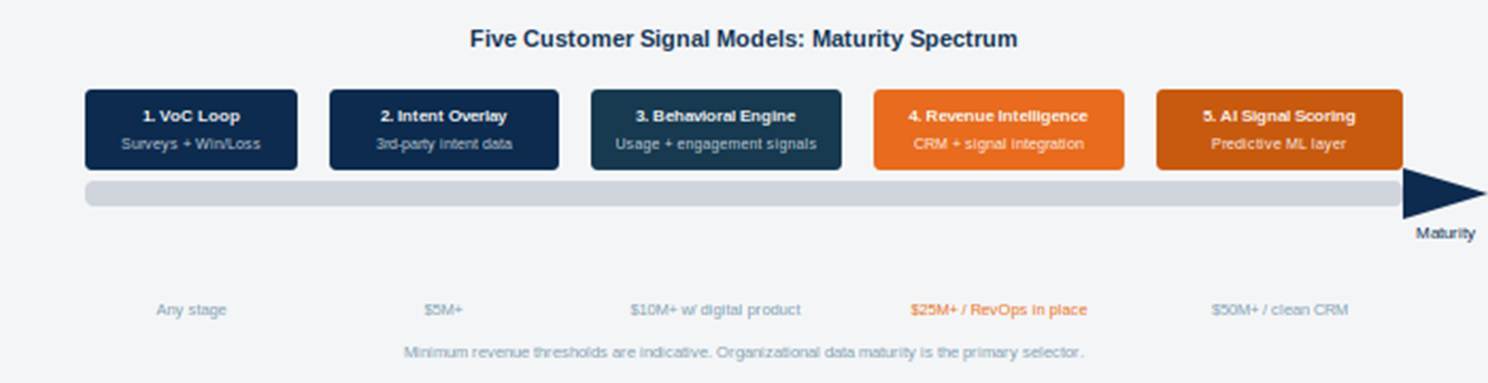
Fig. 1 — Five customer signal models and their indicative revenue thresholds. Organizational data maturity is the primary selector.
1. Voice-of-Customer (VoC) Loop. The foundational model. Structured collection of customer feedback through NPS surveys, win/loss interviews, and support interaction analysis, fed back into product, messaging, and sales play decisions. Gartner and McKinsey both treat this as the minimum viable customer signal infrastructure. For mid-market companies with limited data history, this is the starting point. It requires no technology investment beyond a survey tool and a disciplined quarterly review cadence.
2. Intent Data Overlay. Third-party platforms track which companies are actively researching topics related to your product or category. That intent signal is layered on top of your CRM and used to prioritize outreach timing. Gartner's B2B research shows that intent-informed outreach targets the buying window rather than the seller's schedule. The result: the same outbound effort produces higher conversion rates because the timing is right.
3. Behavioral Signal Engine. For companies with a product or digital touchpoint, usage and engagement data becomes the primary signal layer. Marketing and sales act on what customers are doing, not what they said in a survey six months ago. This model is particularly powerful for identifying expansion potential (high usage, multiple users, new use cases) and churn risk (declining engagement, rising support volume) before either becomes visible in the revenue line. McKinsey's personalization research found that companies excelling at customer intimacy through behavioral signals generate faster revenue growth than peers.[6]
4. Revenue Signal Intelligence. A more mature model that integrates first-party CRM data, third-party intent data, behavioral signals, and conversation intelligence into a single signal layer that marketing and sales run from together. McKinsey identifies this as the model that separates the top 20% of B2B growth performers from the rest, and notes that only 19% of B2B sales forces currently operate at this level.[1] For PE-backed companies preparing for an exit, this infrastructure materially affects valuation multiples because it demonstrates a repeatable, scalable revenue engine, not a personality-dependent sales motion.
5. AI-Augmented Signal Scoring. The emerging model: machine learning applied to the signal layer to predict which accounts are most likely to buy, expand, or churn. Signal-personalized outreach at this level achieves 15 to 25% reply rates compared to 3 to 5% for cold outreach, a five-times improvement that compounds across every downstream metric. This model requires clean underlying data infrastructure. AI accelerates a good signal system. It does not fix a broken one.
How to Select the Right Model
Three questions determine the answer. Answer them honestly, not aspirationally.
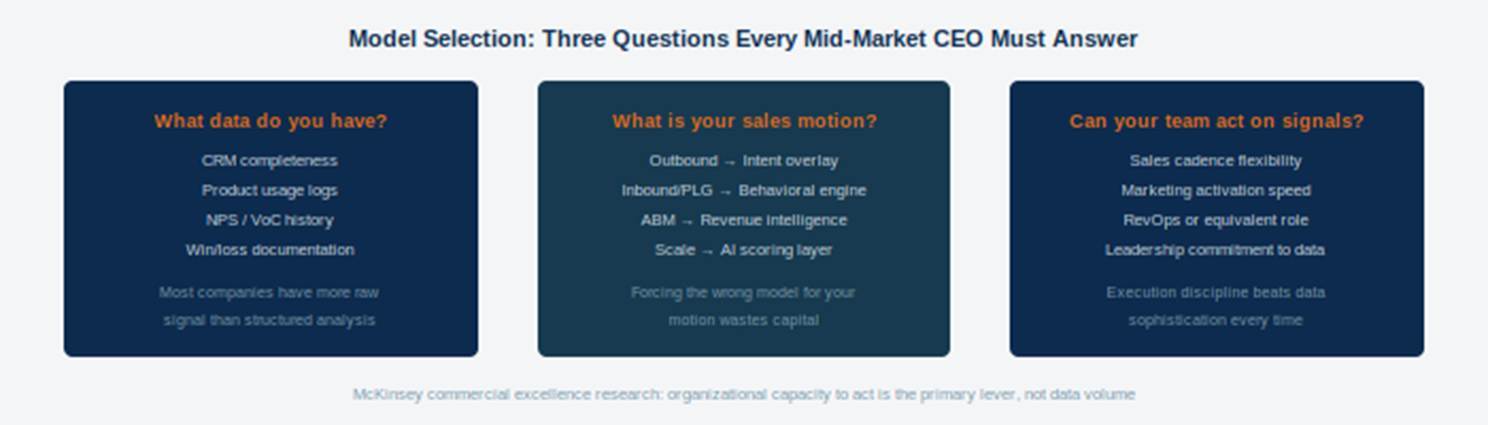
Fig. 2 — Three-question model selector. The right model is determined by data availability, sales motion fit, and organizational capacity to act.
What data do you actually have? Before selecting a model, audit what exists: CRM completeness, product usage logs, NPS history, win/loss documentation. Most mid-market companies discover they have more raw signal than they thought and less structured analysis than they need. The gap is not collection. It is interpretation and activation.
What is your sales motion? Outbound-heavy motions benefit most from intent data overlays. Inbound and product-led motions benefit from behavioral signal engines. Account-based motions need the integrated revenue intelligence model. Forcing a model that does not match your motion wastes capital and creates false confidence in misleading data.
What is your organizational capacity to act on signals? McKinsey's commercial excellence research consistently finds that execution discipline trumps data sophistication when organizational capacity is the bottleneck. A signal infrastructure that surfaces insight your team cannot act on is a cost center. Build the team's capacity to act on a simple signal first, prove the model, then add complexity.
The Benefits Ranked by Commercial Impact
Shorter sales cycles. Engaging accounts at the moment of active interest rather than on a fixed outreach cadence compresses time-to-close. The 2026 B2B GTM benchmark data shows companies moving from MQL-based qualification to intent and signal-based qualification seeing pipeline velocity improvements of 20 to 40%.
Higher win rates. Personalization informed by behavioral signals produces conversion rates 1.7x higher than generic outreach. The math on a mid-market sales team with signal-informed prioritization compounds quickly across a full year of pipeline.
Reduced churn and stronger retention. Companies monitoring behavioral signals for churn indicators intervene before the customer has already decided to leave. Harvard Business Review's retention research makes the profit impact of even modest improvements in retention clear: 25 to 95% profit increase from a 5% retention gain.[4]
Expansion revenue identification. Signal analysis surfaces upsell and cross-sell potential in existing accounts. For mid-market companies, expansion revenue is consistently the highest-margin revenue available. It costs 5 to 7 times less to expand an existing account than to acquire a new one.
Capital efficiency in marketing spend. Signal-informed channel selection and audience targeting means every marketing dollar does more work. For a company operating on a constrained marketing budget, this is the difference between a program that compounds and one that flatlines.
The Implementation Sequence That Works
The companies that fail at customer signal analysis almost always make the same mistake: they buy the technology before they have established the discipline. The sequence matters more than the tools.
1. Audit and clean the CRM. Nothing downstream functions with corrupted or incomplete data.
2. Implement a basic VoC loop. NPS, win/loss analysis, and churn exit interviews generate actionable signal within 60 days and require no technology investment.
3. Add intent data to your outbound motion. One platform, one ICP segment, measured against baseline conversion for 90 days before expanding.
4. Build behavioral monitoring into your existing accounts. Identify your top 20 expansion candidates and top 10 churn risks using data you already have before buying new tools.
5. Formalize a signal review cadence. Weekly or bi-weekly alignment between marketing and sales on what the signals say and what the response will be.
6. Expand the model as organizational capacity grows. Revenue signal intelligence and AI-augmented scoring are the destination, not the starting point.
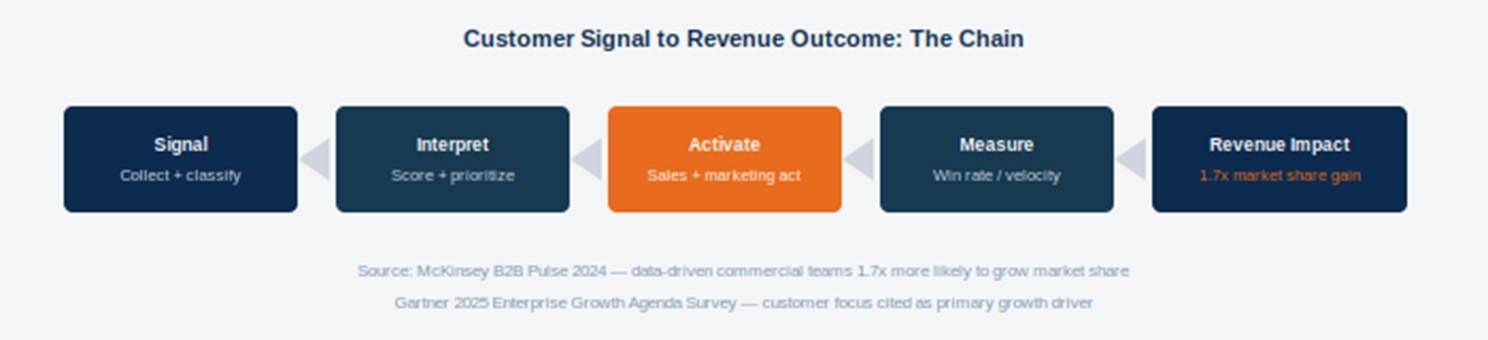
Fig. 3 — The customer signal to revenue outcome chain. Speed of activation at each stage determines competitive advantage.
What This Means for Mid-Market Investors
For PE operating partners and independent sponsors, customer signal infrastructure is increasingly a diligence factor, not just a post-close value creation initiative. A portfolio company that can demonstrate a functioning signal layer, one that shows how marketing spend is aligned with buying intent, how churn is monitored proactively, and how expansion revenue is systematically identified, is a more defensible asset than one that cannot.
McKinsey's commercial excellence framework treats data-driven GTM as a valuation lever. The companies operating at the top of the commercial maturity curve command higher entry valuations and deliver more predictable exit outcomes because their revenue is not dependent on individual relationship management. It is built on a system.
The question worth asking before every portfolio company board meeting: does this company know why its best customers bought, which of its current customers is at risk, and which of its prospects is in an active buying window right now? If the answer to any of those three is no, that is where the next value creation dollar should go.
The signal is already there. Your customers are telling you what they need, when they are ready to buy, and when they are considering leaving. The only question is whether your commercial team is reading it before your competition does.
Citations
[1] McKinsey & Company. 'Five Fundamental Truths: How B2B Winners Keep Growing.' McKinsey B2B Pulse 2024. September 12, 2024. mckinsey.com
[2] Gartner. 'Invest in Customer Understanding in 2025 to Drive Faster Growth.' 2025 Gartner Enterprise Growth Agenda Survey. April 22, 2025. gartner.com
[3] Gartner. 'Gartner Predicts by 2025, 60% of Organizations with VoC Programs Will Supplement Traditional Surveys by Analyzing Voice and Text Interactions with Customers.' February 1, 2022. gartner.com/newsroom
[4] Harvard Business Review. Retention and profitability research, cited across multiple HBR customer experience studies. hbr.org
[5] Gartner. 'The Adaptability Era: 3 Marketing Trends Reshaping B2B Growth.' June 5, 2025. gartner.com
[6] McKinsey & Company. 'The Value of Getting Personalization Right — or Wrong — Is Multiplying.' Next in Personalization Report. mckinsey.com
Erika Rosenthal is Managing Partner of Veritac Group, a fractional GTM execution firm for PE-backed and investor-backed mid-market companies. She has 25+ years of operating experience including CEO, COO, and CMO roles across healthcare, SaaS, and services sectors. veritacgroup.com | erika@veritacgroup.com