We Help to Execute GTM Strategy in Addition to Advising.
Most GTM strategies die between the strategy deck and execution. Veritac Group builds go-to-market strategies for mid-market companies. We understand ICP definition, channel strategy, demand generation, and sales alignment as experienced former operators. We are fast and effective.










.png?width=128&height=38&name=trans%20light%20logo%20(1).png)
.png?width=96&height=38&name=trans%20light%20logo%20(2).png)


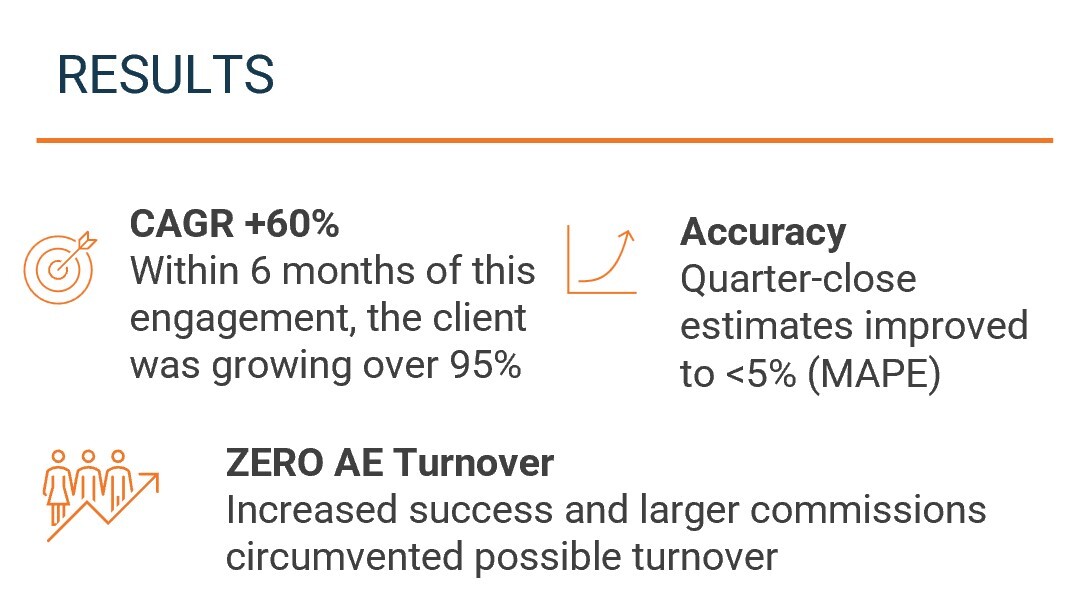
95% Growth in 6 Months: How a PE-Backed SaaS Company Fixed the Pipeline Problem Nobody Could Name
Industry: SaaS
Company Size: <100 Employees
Ownership: Private Equity
Situation
"They should be growing faster."
-
The Lead Investor put it plainly: “they should be growing faster."
-
Three consecutive quarters of missed targets had the CEO and board frustrated.
-
Two years of triple-digit growth had given way to a 35% YoY trend, and large deals kept pushing without explanation.
-
Sales and Marketing teams were capable, but the pattern of failure was eroding morale.
-
The company has a well-regarded selling methodology in place. What it did not have was a mapped, codified customer journey in its CRM, a functional ICP, or a lead management process that matched how buyers made decisions. The methodology was there. The infrastructure to run it was not.
Approach
Diagnose, Build, Execute then Coach
-
Defined the ICP and buyer personas from closed-won data, not aspiration. Documented the actual customer buying pattern and built it into the CRM
-
Developed a lead management and sales process aligned to buyer needs and deal progression stages.
-
Revised lead scoring and prospect grading based on new ICP and journey definition
Delivery
Maturing the GTM team; processes, people and tools
-
Diagnosed execution gaps by observing AE weekly coaching sessions directly Shifted 1:1 coaching from deal inspection to opportunity development, directly improving win rates §Introduced firm stage gates to improve pipeline accuracy and forecast reliability
-
Trained the entire GTM organization on the new process and CRM hygiene requirements
-
Coached front-line managers and sales leadership to run more effective rep interactions
-
Improved win rates and larger commissions removed the turnover risk that had been building under a losing streak. The team that was capable all along started performing like it. The combination of accelerating growth and defensible forecast accuracy is what PE sponsors need to feel confident in a business heading toward exit. Both improved within a single operating quarter.
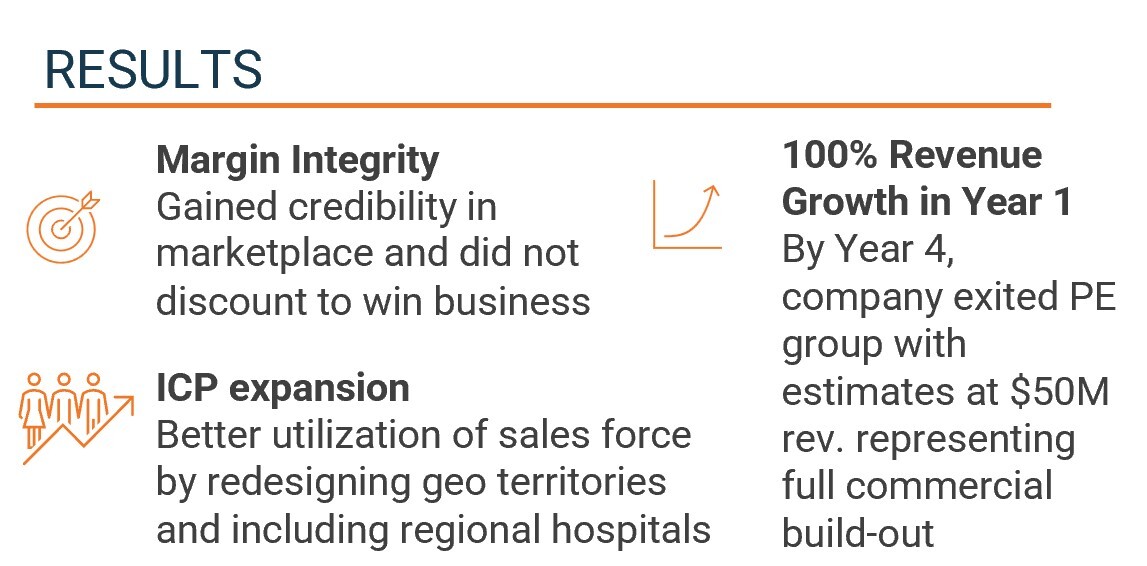
$9M Revenues to $50M, and an Exit: Breaking Into an Entrenched Market with Moats without Cutting Price
Industry: Medical Device
Company Size: 150+
Ownership: Private Equity
Situation
How can the company increase awareness and generate more business while shortening customer acquisition cycle time?
-
The device produced better clinical outcomes with more efficiency than what was already in the market.
-
The problem was a competitor deeply entrenched with health systems, buying cycles that ran 2 to 5 years, and a $9M revenue base burning through capital with a national sales force that needed better focus.
-
The company needed market awareness, a credible clinical story, and a demand generation system that could compress the acquisition cycle without discounting its way to revenue.
Approach
Analyzed ICPs against market data and built a top-of-the-funnel awareness plan grounded in buyer behavior, not feature promotion.
-
Developed new messaging built around clinical outcomes and stakeholder results, replacing a feature-and-benefit narrative that was not moving health system buyers
-
Created a health economics study for Hospital Value Analysis Committees, documenting better patient outcomes, cost savings, reduction in rehospitalizations, and improved OR decision-making data
Delivery
Account Segmentation – Revised ICPs and redesigned geographic territories of sales reps. Started BDR group to optimize efficiency and produce more qualified leads.
CRM Optimization – Aligned sales and marketing teams on definitions of each stage of pipeline + exit criteria to improve lead flow. Re-mapped territories to include regional hospitals with faster acquisition cycle times.
Improved Market Awareness – Published health economics study; initiated PR program garnering major articles and awards, and gained $30M in ad equivalency in media relations, creating awareness and 3rd party credibility that sales could not generate alone
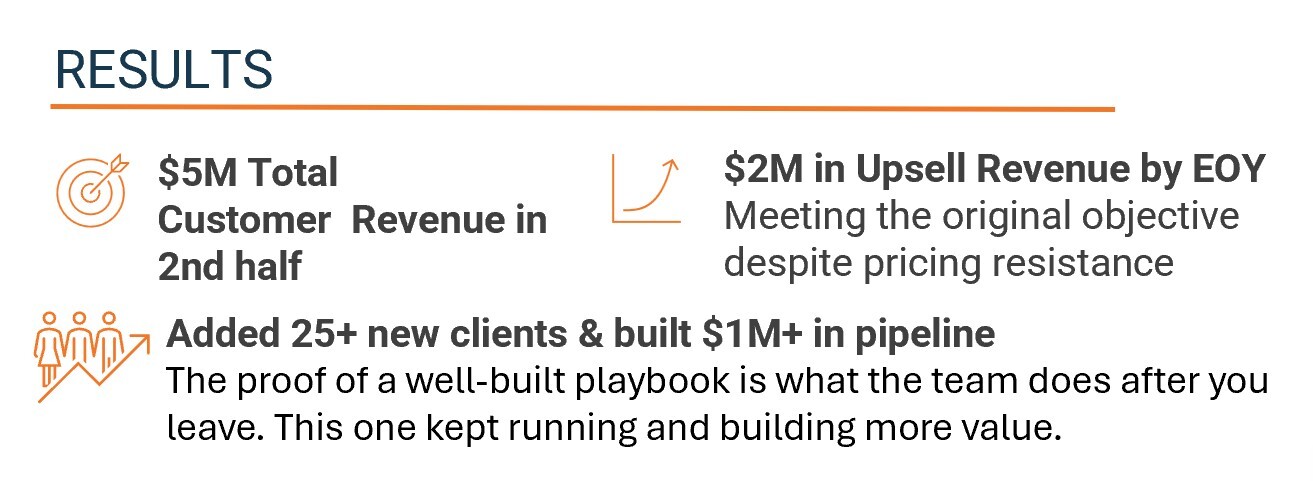
New Product. Resistant Buyers. Pricing Pushback. >$5M Revenue in 2 Quarters.
Industry: SaaS
Company Size: $50-$60MM Revenue
Ownership: Private Equity
Situation
A PE-backed SaaS company needed to do three things at the same time: replace a departing growth leader, execute a new product launch to an existing customer base, and defend a higher price point that the market was not yet sold on.
-
The product was good. The ask was harder than expected. The existing customer base pushed back on the new pricing, and the account management team, responsible for both renewals and upsell, lacked a structured approach for either.
-
The challenge was compounded by a global footprint: the European team faced an even tougher conversion problem given their smaller client profiles. The company had a window to hit the number. It needed a playbook, leadership coverage, and execution support, all at once.
Approach
Develop & Implement Sales Playbook for new Product Launch.
-
Perform Customer Segmentation analysis across US and European markets to identify accounts with the highest ICP fit for new product
-
Built account-level strategies and presentations for priority accounts
-
Interviewed leadership and key account managers to surface the actual objections and identify the highest-converting approach
-
Developed distinct playbooks for US and European markets, built in partnership with Sales and Marketing
Delivery
Implemented new sales approach and tracking for entire Account Management team across US & Europe.
-
Created a weekly tracking process with Finance to maintain line-of-sight on progress against targets
-
Led hands-on coaching for individual account managers and team leaders throughout engagement
-
Implemented a short-term incentive program aligned to the new product launch to drive focus and accountability
-
Transitioned programs to a new permanent leader upon exit
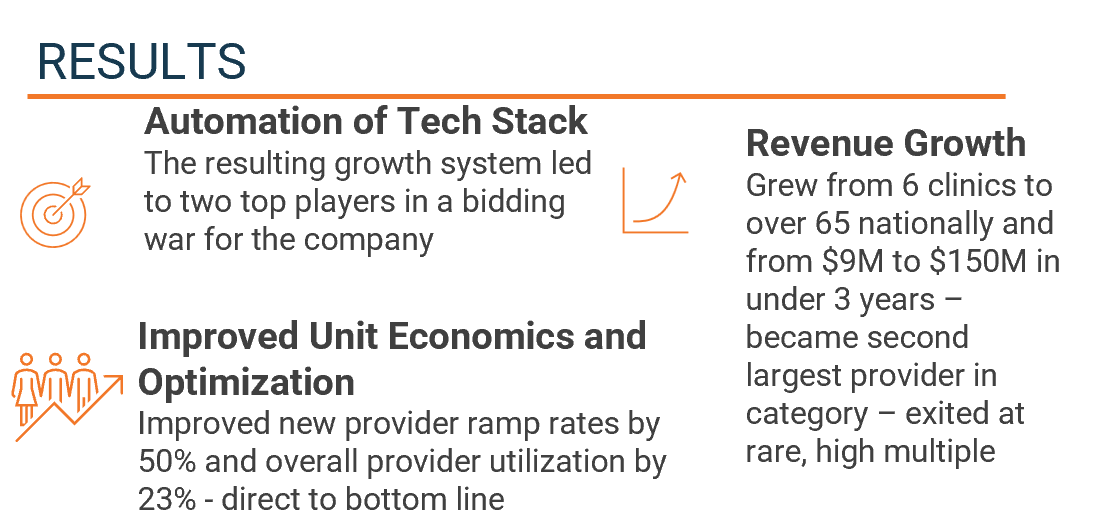
$9M to $150M in Under 3 Years: Building the Commercial Infrastructure Behind a National Healthcare Expansion
Industry: Healthcare services
Company Size: $9M
Ownership: Private Equity
Situation
How can company scale from 6 clinics in one state to become largest provider of services in category nationally?
-
Six clinics. One state. A PE sponsor with a national expansion thesis and a timeline of 3-5 years.
-
Company was growing through both de novo openings and acquisitions, but the growth infrastructure was not keeping pace. There was no reliable model for identifying the best markets to enter. New provider ramp rates were slow. Scheduling was decentralized, which meant capacity was being wasted at the unit level.
-
Multiple systems were not connected, leaving the leadership team without the real-time visibility needed to make fast decisions. The business needed a growth engine, not a bigger version of what it already had.
Approach
Gain economies of scale in brand so that unit economics were more profitable and quality of care was enhanced.
-
Designed a hub-and-spoke expansion model and ran market analysis to identify the highest-potential locations based on payor mix, demand signals, and acquisition target density
-
Centralized new patient scheduling into a national call center to optimize provider utilization, reduce wait times, and route qualified patients faster
-
Implemented a CRM to improve lead conversion, standardize intake processes, lower CAC, and provide real-time data to leadership
Delivery
-
Developed a B2B and B2C marketing and sales motion to support both provider recruitment and patient acquisition
-
Supplied data to help negotiate improved payor contracts and rates to strengthen unit economics
-
Built a KPI dashboard giving leadership a real-time view of what was working and where to pivot
-
Automated patient paperwork, accelerated reimbursement timelines, and improved the experience of both patients and providers
-
Created a clear value proposition in the marketplace that supported acquisition targets and demand generation simultaneously
-
Media relations program resulted in $45M in ad equivalence and stimulated demand among providers and patients
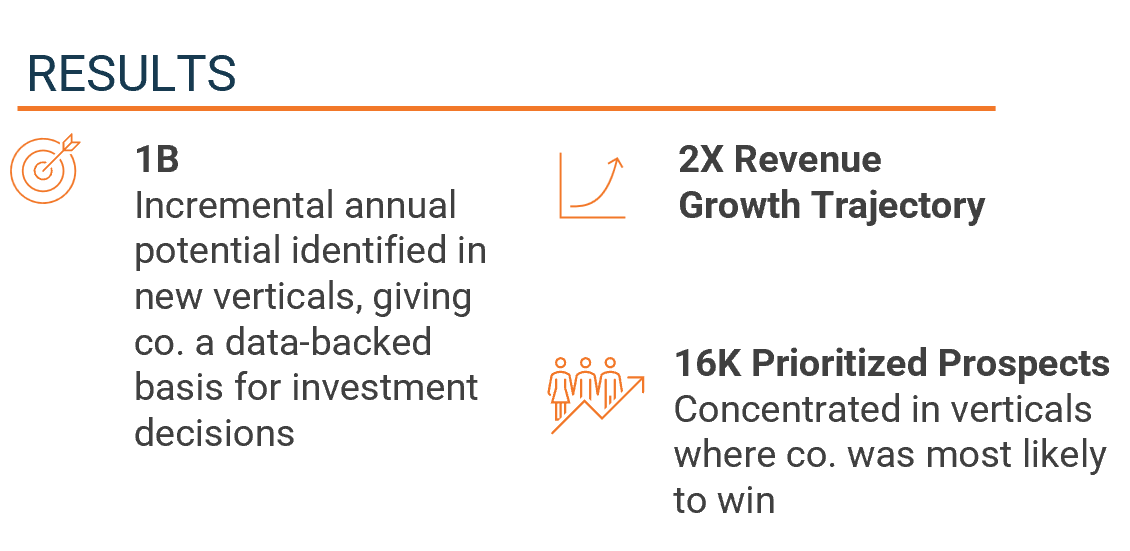
Finding the Next $1B: Resetting a Market Expansion Strategy Before the Core Business Eroded
Industry: Software
Company Size: 5,000+
Ownership: Private
Situation
How can company grow revenues while protecting its core business and differentiating in their vertical segment?
-
The core business was commoditizing. It represented 80% of total revenue, and the pricing pressure was not slowing down.
-
The company had set a target to double revenue by and knew it could not get there by defending what it already had.
-
The path forward required entering new verticals with new products, selling to new buyer types, and doing it with sales talent that had not been hired yet.
-
In addition, Company was mid-implementation of an indirect partner program, adding another layer of complexity to an already stretched commercial organization.
-
The strategic question was where to go first, and how to sequence the investment.
Approach
Segment accounts to identify which opportunities to prioritize first.
-
Built a bottom-up account segmentation from the ground up, combining existing company data with newly created data sets that had not previously existed.
-
Identified the composition of the current account base to establish a baseline for what was already working and why
-
Sized each potential new vertical to help the company prioritize where to commit resources first
Delivery
-
Built a prospect identification list of 16,000 accounts in the highest-priority verticals as an actionable starting point for sales
-
Provided specific guidance on where to deploy new partner resources for maximum early return
-
Enabled a sales reorganization structured around the verticals with the highest validated potential
-
Balanced territory-level assignments within areas of greatest opportunity