#PrivateEquity #GrowthStage
Discover the essential strategies for CEOs and investors to successfully navigate the growth chasm from $20M to $200M in revenue.
A strategic roadmap for CEOs and PE operating partners navigating the most treacherous—and rewarding—phase of business growth.
by Erika Rosenthal, Managing Partner, Veritac Group
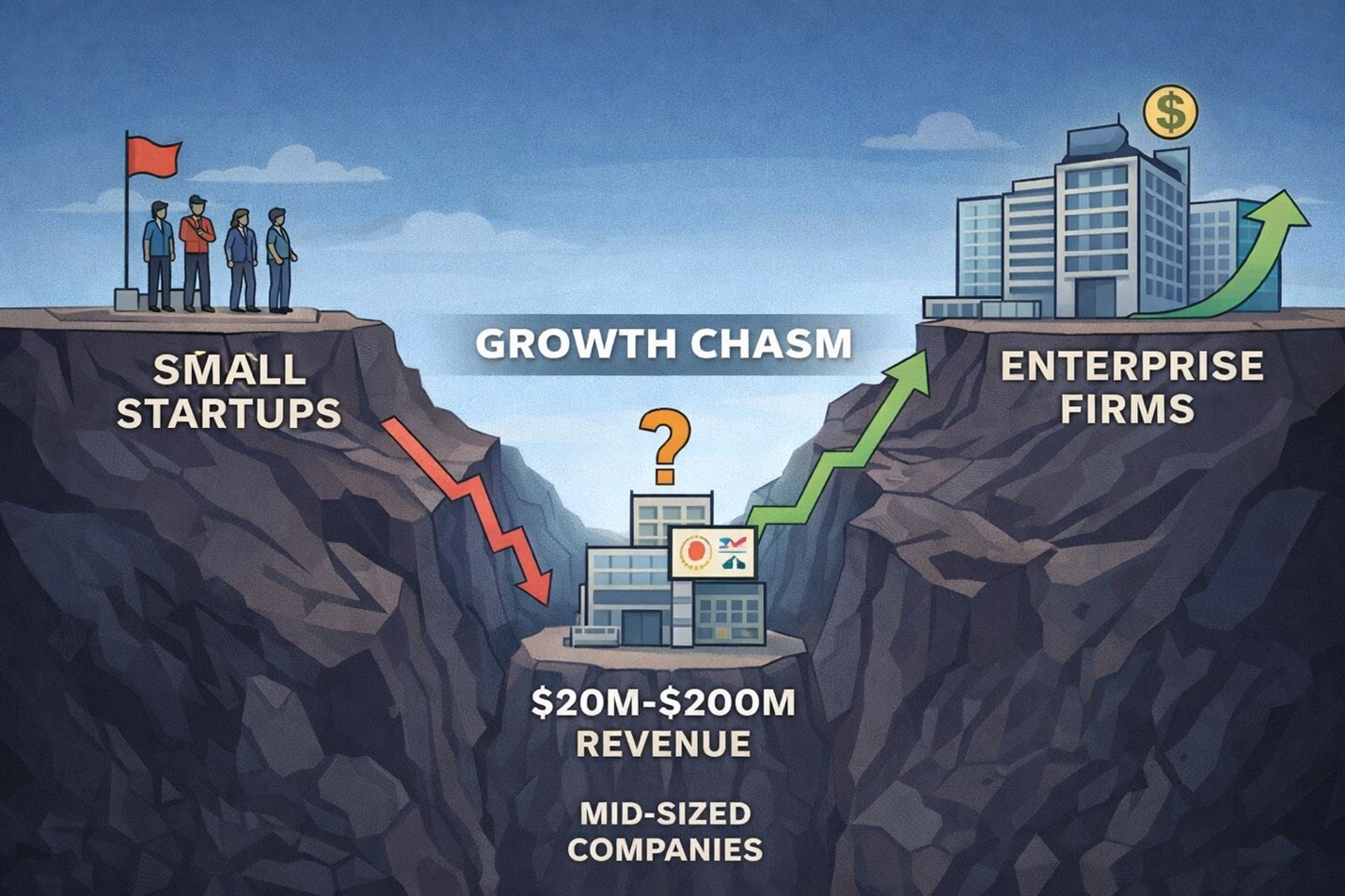
The journey from $20 million to $200 million in revenue is where promising companies either transform into industry leaders or collapse under the weight of their own complexity. This middle passage, often called the "growth chasm", claims more ambitious businesses than any other phase of development. For those who navigate it successfully, the rewards are extraordinary: market dominance, the operational foundation for continued expansion, and premium valuations.
Hustle, grit, and improvisation will not be enough for this stage. The Founder heroics that got the company to $20 million must transition to systematic execution. Tribal knowledge must transform into documented processes. And the personal relationships and early go-to-market motions require complete reimagination to capture enterprise accounts and new market segments.
For private equity investors and the CEOs they back, understanding this transition and devising the right growth engine isn't optional; it's the difference between portfolio companies that deliver exceptional returns and those that stagnate at the complexity ceiling.
The Anatomy of the Growth Chasm
The mid-market represents a distinct competitive arena. Companies with revenues between $20 million and $200 million are too large to operate like startups but lack the resources, infrastructure, and processes of scale that enterprise organizations. They face pressure from both directions: nimble upstarts eating into their base, while established players leverage scale advantages.
The data reveals how consequential this phase is. According to research from Bain & Company, companies that successfully deploy commercial acceleration strategies across sales, marketing, and pricing typically unlock 10–20% top-line growth and 10–15% EBITDA improvement, with an average ROI 20–30% higher than cost-cutting initiatives alone. veritacgroup.com
For many mid-market companies, the challenge is not whether growth is possible, but whether the business has built the commercial engine to support it. Bain finds that companies that improve commercial capabilities across sales, marketing, and pricing can generate 10% to 20% faster top-line growth and 10% to 15% EBITDA improvement, with returns that outperform cost-cutting-only approaches. McKinsey reports a similar payoff: companies with data-driven B2B sales-growth engines achieve above-market growth and 15% to 25% EBITDA gains. Deloitte adds an important clue about why some firms pull ahead while others stall: among mid-market companies studied, the faster growers invested more aggressively in technology and infrastructure, with 66% allocating more than 5% of revenue to technology, compared with 46% of slower-growth peers. The message is hard to ignore. Growth in the middle market is not just a market problem; it is an execution and scaling problem.
The companies that break through share common characteristics: they recognize that scaling requires fundamentally different capabilities than starting, they invest in systems before they're strictly necessary, and they treat go-to-market excellence as a strategic priority rather than a tactical afterthought.
The Four Pillars of Scalable Growth
Drawing from the Scaling Up methodology developed by Verne Harnish and refined by practitioners working with hundreds of mid-market companies, sustainable growth rests on four interdependent decisions that leadership must get right. slaff.io
People: Building the Team That Can Build the Company
The team that got you to $20 million is rarely the team that will get you to $200 million; not because they lack talent, but because the roles themselves transform beyond recognition.
At the startup stage, you need generalists who can wear multiple hats and thrive in ambiguity. At scale, you need specialists who bring deep functional expertise and can build departments rather than just fill seats. The VP of Sales who personally closed your first enterprise deals may struggle to build the systems, hire the team, and manage the pipeline required when you need 20 reps producing consistently.
This transition is often difficult. Founders often have deep loyalty to early employees who took personal risks to join the company. But misaligned talent in leadership roles creates cascading problems: missed targets, burned-out teams, and the slow erosion of competitive position.
Retention also becomes a challenge. According to SHRM data, 58% of mid-sized businesses face talent retention issues, which directly hinders their ability to execute growth strategies.
The UHY Middle Market Survey 2025 revealed that 29% of mid-market firms consider talent retention their most significant workforce challenge. Turnover directly hinders the ability of a company to execute strategies.
Successful scaling companies address this challenge through several mechanisms:
- Role clarity and evolution. They define the requirements for each leadership role at the current scale and at 3x scale, then honestly assess whether existing leaders can grow into the expanded requirements—or whether the kindest path for everyone involves transitioning them to roles that better match their strengths.
- Systematic hiring infrastructure. They move beyond founder-network recruiting to building talent acquisition as a core competency, including employer branding, structured interview processes, and competitive compensation benchmarking.
- Leadership development investment. They recognize that promoting from within requires intentional development, not just hope that high performers will figure out management on their own.
- Cultural codification. They document and reinforce the values and behaviors that made the company successful, recognizing that culture becomes harder to maintain organically as headcount grows.
Strategy: Simplicity That Scales
The cause
The most common strategic failure in scaling companies is increasing complexity. Early success in a core market often leads to opportunistic expansion: adjacent products, new customer segments, international markets, and strategic partnerships. Each initiative may seem logical in isolation. But together, they fragment focus, strain resources, and dilute competitive advantage. Other common practices that add complexity include implementing more technology with systems that don’t communicate with each other, and siloing data, making it hard to find. Retrospective data causes reactive actions and leads to delays when timing is critical.
Companies that successfully navigate from $20 million to $200 million typically do so by narrowing their strategic focus rather than expanding it, at least initially. They identify the core value proposition that drives customer loyalty and double down on delivering it better than anyone else.
Market expansion and diversification remain important growth levers, but timing matters enormously. Research from Bain & Company found that companies that successfully expand into new markets achieve 20% higher revenue growth compared to those that don't, but failed expansion attempts destroy value even faster.
The Australian company Afterpay illustrates successful international expansion done right. After establishing market leadership in buy-now-pay-later services domestically, they expanded methodically into international markets, including the United States and United Kingdom. The key was sequencing: they proved the model, built the operational infrastructure, then expanded, rather than trying to do everything simultaneously.
Strategic clarity also enables better resource allocation. When everyone in the organization understands the two or three things that matter most, decision-making accelerates at every level. Employees don't need to escalate routine decisions because they understand the strategic context well enough to make good calls independently.
Execution: Systems That Eliminate Drama
At startup scale, execution relies on heroic individual effort. The founder personally intervenes to save the critical deal. The engineer works through the weekend to ship the feature. The customer success manager performs miracles to retain the upset client.
These heroics suffice, until they don't. As volume increases, individual efforts become unsustainable. The founder can't be in every sales meeting. The engineer burns out. The customer success manager can only save so many accounts through sheer willpower.
Scaling companies demands systems: documented processes, clear accountability, regular operating rhythms, and metrics that provide early warning when execution drifts off track.
The Scaling Up framework calls for consistent meeting rhythms, daily huddles, weekly tactical meetings, monthly strategic reviews, and quarterly planning sessions that keep teams aligned without requiring constant ad-hoc coordination. These meetings follow structured agendas and produce documented outcomes, creating a drumbeat that drives execution forward.
McKinsey research quantifies the execution premium: focused pricing programs alone can produce 3–7 percentage points of margin improvement. Stronger margins and revenue yield higher EBITDA. veritacgroup.com
Execution excellence compounds over time. Each quarter of consistent delivery builds organizational muscle memory. Teams learn to anticipate problems rather than react to crises. The business becomes more predictable, which enables better planning, which enables improved and consistent execution; a virtuous cycle that separates scaling companies from those that remain perpetually chaotic.
Cash: The Oxygen of Growth
Rapid growth requires investment. For product companies, this means cash or credit for purchasing and holding Inventory. Before a company achieves revenue, it must hire, train, and pay salespeople. Building the lead pipeline for those salespeople requires Marketing investments. The faster a company wants to grow, the greater the working capital needed.
Many promising companies have grown themselves into bankruptcy, not because the business model was flawed, but because they didn't manage the cash conversion cycle aggressively enough to fund their expansion.
The Scaling Up framework emphasizes understanding and optimizing three key levers:
- Sales cycle length. How long does it take from initial contact to a closed deal? Shortening this cycle accelerates cash flow and reduces the resources tied up in pipeline management.
- Delivery cycle. How long between when a deal closes and when you've fully delivered the promised value? Faster delivery enables quicker invoicing and collection.
- Payment cycle. How long after invoicing do you actually receive cash? Payment terms, collection processes, and billing timing all impact cash flow.
Companies that master these levers can often fund growth internally, reducing dependence on external capital and preserving equity value for existing shareholders. Those that ignore them find themselves perpetually raising money at dilutive valuations or, worse, running out of runway entirely.
The Veritac Group APRO™ Framework: From Diagnosis to Scale
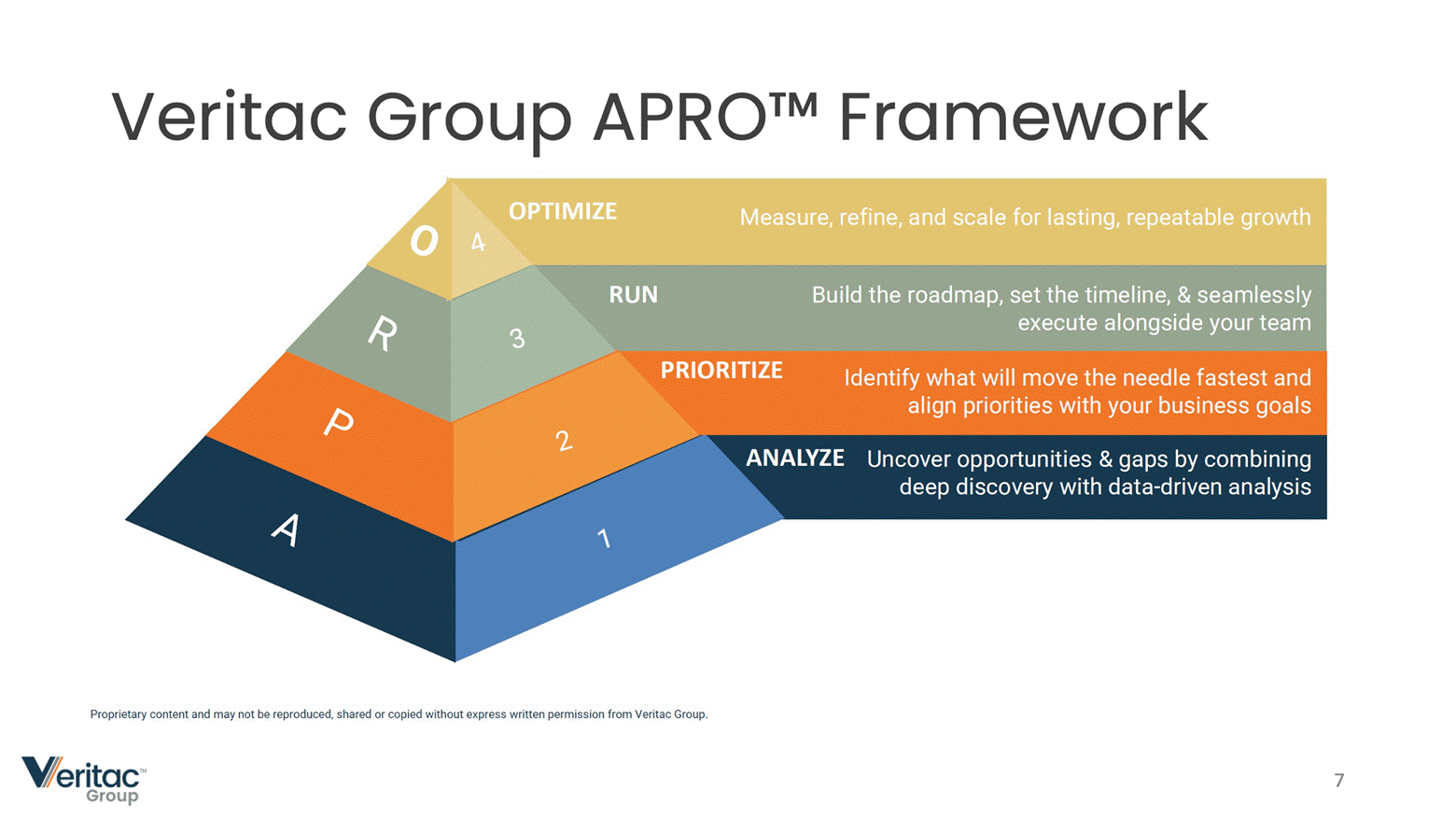
While the four pillars provide a strategic foundation, mid-market companies need a practical methodology for implementation. The Veritac Group APRO™ Framework offers exactly this: a systematic approach to diagnosing growth challenges and executing solutions that compound over time.
Phase 1: Analyze
Every scaling initiative must begin with an honest assessment. The Analyze phase combines deep discovery with data-driven analysis to uncover both opportunities and gaps.
This examination isn't about surface-level benchmarking or generic best practices. Effective analysis requires understanding the specific dynamics of your business: customer acquisition costs by channel and segment, lifetime value by cohort, win rates by competitor and deal size, churn drivers and expansion patterns, sales productivity by tenure and territory.
Most mid-market companies have some of this data, but it's fragmented across systems, inconsistently defined, and rarely synthesized into actionable insight. The Analyze phase builds the diagnostic foundation that enables everything that follows.
Key questions this phase answers:
- Where are we winning, and why?
- Where are we losing, and what would it take to change that?
- Which customer segments offer the highest growth potential at an acceptable cost?
- What operational bottlenecks constrain our ability to scale?
- How does our performance compare to relevant benchmarks, and what explains the gaps?
Companies that skip or shortcut this phase inevitably misallocate resources in subsequent phases. They optimize the wrong channels, target the wrong segments, or focus on solving problems that aren't actually constraining growth.
Phase 2: Prioritize
Analysis generates insights; prioritization translates them into action. The Prioritize phase identifies what will move the needle the fastest and aligns those priorities with overall business goals.
The challenge here is focus. Analysis typically reveals multiple opportunities, each with legitimate potential. The temptation is to pursue all of them. But resource constraints in mid-market companies make this approach suicidal; you end up doing many things poorly rather than a few things well.
Effective prioritization requires an honest assessment of:
- Impact potential. How much could this initiative move key metrics if executed well?
- Confidence level. How certain are we that execution will produce the expected results?
- Resource requirements. What investment of time, money, and attention does this require?
- Dependencies. What must be true or in place for this initiative to succeed?
- Opportunity cost. What are we not doing by choosing this?
The output is a ranked list of initiatives with a clear rationale for sequencing. This prioritization becomes the input for roadmap construction in the next phase.
Phase 3: Run
Strategy without execution is hallucination, like a bad AI trip. In the Run phase, we build the roadmap, set the timeline, and execute seamlessly alongside your existing team.
This phase is where most growth initiatives fail. Companies conduct impressive analyses, build compelling strategies, and then stumble in implementation. The day-to-day demands of running the business crowd out the new initiatives. Priorities shift as urgent issues arise. Accountability diffuses across the organization until no one owns the outcome.
Effective execution requires:
- Clear ownership. Every initiative has a single accountable individual with the authority and resources to drive it forward.
- Defined milestones. Abstract goals become concrete deliverables with specific deadlines.
- Regular cadence. Weekly or biweekly reviews keep initiatives on track and surface blockers early.
- Resource protection. Dedicated capacity ensures initiatives don't get sacrificed to daily firefighting.
- Rapid iteration. Early signals inform adjustments rather than waiting until the end to discover problems.
The Run phase treats execution as a discipline to be mastered, not an afterthought to be managed.
Phase 4: Optimize
Growth is not a destination; it's a continuous process. In the Optimize phase, we measure results, refine approaches, and scale successful initiatives for lasting, repeatable growth. The adjustments in this phase lay the groundwork for automation and technology to make the growth system faster. Here is where companies begin to pull away from their competition, leaving them behind.
The Optimization phase closes the loop that began with analysis. Results from execution feed back into improved understanding. What worked? What didn't? What did we learn that changes our view of the opportunity landscape?
Optimization operates on multiple time horizons:
- Immediate adjustments. Weekly and monthly refinements based on early performance signals.
- Quarterly reviews. Deeper assessment of initiative portfolios and resource allocation.
- Annual recalibration. Fundamental reassessment of strategic direction and capability requirements.
Companies that treat growth as a one-time project rather than an ongoing discipline eventually see their gains erode. Markets shift, competitors adapt, customer expectations evolve. Continuous optimization keeps the growth engine running.
Go-to-Market Excellence: The Hidden Driver of Exit Multiples
For private equity investors evaluating mid-market opportunities, go-to-market capability is often the most underappreciated value driver. Revenue growth gets attention in investment memos, but the underlying commercial engine that produces that growth receives less scrutiny.
This oversight is a mistake. Research consistently shows that GTM excellence correlates strongly with both growth sustainability and exit valuations.
Companies with mature customer success functions outperform peers on multiple dimensions: 12% higher revenue growth, 19% higher gross margins, 15% better retention, and 25% higher customer lifetime value. veritacgroup.com
The mechanism is straightforward: buyers pay premiums for predictability. A strong, scalable revenue model anchored in an aligned GTM reduces risk and supports higher valuations at exit. When portfolios have GTM playbooks that deliver consistent results, investment committees bid more aggressively.
The components of GTM excellence in mid-market companies include:
- Integrated revenue operations. Sales, marketing, and customer success operate from shared data, aligned incentives, and coordinated playbooks rather than functional silos.
- Defined ideal customer profiles. The organization knows exactly which prospects convert at an acceptable cost, expand over time, and refer others, all while allocating resources accordingly.
- Scalable sales processes. Documented methodologies, standardized tooling, and consistent coaching enable new hires to ramp quickly and produce predictably.
- Demand generation engine. Marketing produces a qualified pipeline at volume, with clear attribution and optimization feedback loops.
- Customer success motion. Proactive engagement drives adoption, expansion, and renewal rather than waiting for problems to surface.
- Revenue intelligence. Leadership has real-time visibility into pipeline health, forecast accuracy, and early warning indicators.
Building these capabilities requires investment, but the returns justify it. According to various industry analyses, recurring revenue businesses with high margins and predictable client contracts routinely attract revenue multiples between 5x and 8x, thanks to scalability and retention. veritacgroup.com
Digital Transformation as a Growth Accelerator
The mid-market companies achieving the strongest growth trajectories are increasingly leveraging digital transformation as a competitive weapon. A McKinsey study found that companies investing in digital transformation and innovation achieve 20% higher revenue growth and 15% higher profit margins.
But digital transformation in mid-market companies looks different from that in enterprises. Resource constraints require focus on high-impact, achievable initiatives rather than comprehensive platform overhauls.
The most effective approach prioritizes:
- Customer-facing digitization. Making it easier for customers to buy, use, and expand their relationship with your company.
- Revenue process automation. Eliminating manual work from lead management, proposal generation, contract execution, and billing.
- Analytics infrastructure. Building the data foundation that enables insight-driven decision-making.
- Integration architecture. Connecting fragmented systems to enable data flow and process automation.
Companies that sequence these investments correctly create compounding advantages. Each capability enables the next. Customer-facing improvements generate more data. Better data enables smarter automation. Smarter automation frees capacity for higher-value activities.
Those who try to do everything simultaneously often accomplish nothing. The mid-market digital transformation playbook is as much about sequencing and focus as it is technology selection.
The AI Inflection Point
The emergence of practical AI capabilities adds a new dimension to mid-market growth strategy. As one industry observer noted, AI products are inverting traditional discovery sequences; they reveal capabilities users didn't know they needed. fourweekmba.com
For mid-market companies, AI presents both opportunity and threat. The opportunity lies in leveraging AI to achieve capabilities previously available only to much larger organizations: sophisticated personalization, predictive analytics, automated content generation, and intelligent customer service.
The threat comes from AI-native competitors who achieve scale economies without the traditional infrastructure investment. A startup with AI-powered sales development can likely compete for the same accounts as your 50-person sales team at a fraction of the cost.
The tactical playbook for AI adoption in mid-market companies emphasizes:
- Front-load experimentation. Spend 3-6 months of intense, founder-led testing before expecting flywheel effects. The heavy lifting happens upfront, not optimizing ad spend, but raw discovery of how to reach users. fourweekmba.com
- Optimize for "aha" moments. Rather than traditional conversion metrics, focus on time-to-value, i.e., how quickly can you demonstrate transformative capability to prospects and customers?
- Embrace binary outcomes. AI-driven growth curves are often non-linear: there may be flatness until the flywheel catches, then explosive growth, or nothing. fourweekmba.com
Mid-market CEOs don't need to become AI experts, but they do need to understand how AI changes competitive dynamics in their markets and ensure their organizations are positioned to adapt.
Implementation: The First 90 Days
For CEOs and PE operating partners ready to apply these principles, the first 90 days establish the foundation for everything that follows.
Days 1-30: Honest Assessment
Conduct a comprehensive analysis of the current state across the four pillars of effective GTM: people, strategy, execution, and cash. Gather quantitative data and qualitative input. Benchmark against relevant peers. Identify the three to five most significant constraints on growth.
Resist the temptation to start fixing things before you understand them. The goal is accurate diagnosis, not immediate action.
Days 31-60: Strategic Alignment
Based on assessment findings, develop a prioritized roadmap for the next 12-24 months. Define what success looks like with specific, measurable targets. Align the leadership team around the plan. Clearly communicate the vision and direction to the broader organization.
The output is a clear picture of where you're going and why, with enough detail to enable coordinated action across functions.
Days 61-90: Execution Launch
Kick off the highest-priority initiatives with clear ownership, defined milestones, and regular review cadence. Establish the operating rhythms that will sustain execution over time. Begin building the capabilities required for subsequent phases.
Early wins make a difference, not because they'll transform the business immediately, but because they demonstrate that progress is possible and build momentum for the longer journey.
The Compounding Effect of Getting This Right
The companies that successfully navigate from $20 million to $200 million don't do so through a single breakthrough. They build capabilities that compound over time.
Better GTM execution produces more predictable revenue, which enables better planning, which improves resource allocation, which accelerates capability building, which enhances GTM execution further. Each turn of this cycle increases the gap between scaling companies and those stuck in perpetual struggle.
Deloitte research found that 80% of mid-market companies with robust scaling strategies reported improved operational efficiency and enhanced stakeholder confidence. That confidence enables better talent acquisition, customer relationships, and partnership opportunities, further accelerating growth.
The reverse is equally true. Companies that fail to invest in scaling capabilities find themselves in a negative spiral. Inconsistent execution erodes customer trust. Talented employees leave for better-run competitors. Investors lose patience and withhold growth capital. The gap between potential and performance widens until the business becomes essentially unscalable.
The Path Forward
While mid-market growth challenges are real, they are fixable. The companies that successfully address these challenges share common characteristics: they recognize that scaling requires different capabilities than their startup phase, they invest in systems before they're strictly necessary, they treat go-to-market excellence as a strategic priority, and they execute with discipline over extended time horizons.
For private equity investors, identifying these characteristics in potential investments and building these capabilities in portfolio companies is the most reliable path to exceptional returns.
For CEOs, the message is equally clear: the phase you're in demands deliberate transformation. The approaches that produced early success will not produce scaled success. Embrace the discomfort of changing what's working before it stops working and invest in the capabilities your future company needs.
The journey from $20 million to $200 million is difficult. It's also navigable. And for those who make it through, the rewards in enterprise value, market position, and organizational capability are substantial enough to justify the effort required.
Veritac Group partners with mid-market companies and private equity firms to unlock growth through an integrated go-to-market strategy, execution, and optimization. The APRO™ Framework has been deployed across dozens of portfolio companies to drive measurable revenue acceleration and exit multiple expansions.