#PrivateEquity #RevOps #Consultants #GrowthExperts
Discover 10 frameworks for mid-market companies to audit revenue systems, ensuring effective scaling while addressing ICP alignment and pipeline quality.
By Erika Rosenthal, Co-Founder and Managing Partner, Veritac Group
Mid-market companies face a paradox. They have enough traction to prove the model works, but not enough margin for error to survive scaling the wrong things. Growth capital is available. The pressure to deploy it is real. And the temptation to solve revenue problems with more pipeline, more headcount, more spend, is constant.
More is not a strategy. More amplifies whatever already exists. If the underlying system is sound, more accelerates growth. If the system is broken, more accelerates burn.
The companies that scale efficiently share a common trait: they diagnose before they invest. They audit their revenue systems with the same rigor they apply to financial due diligence. They find the constraints, fix the leaks, and only then add fuel.
This playbook introduces ten diagnostic frameworks designed for mid-market leadership teams: CEOs navigating growth transitions, investors conducting operational due diligence, and revenue leaders trying to separate signal from noise. Each framework addresses a specific failure mode that shows up repeatedly in companies between $10M and $100M in revenue.
The goal is not to create busywork. The goal is to surface the handful of high-leverage issues that determine whether growth compounds or stalls.
Framework 1: The 5-Step ICP Audit
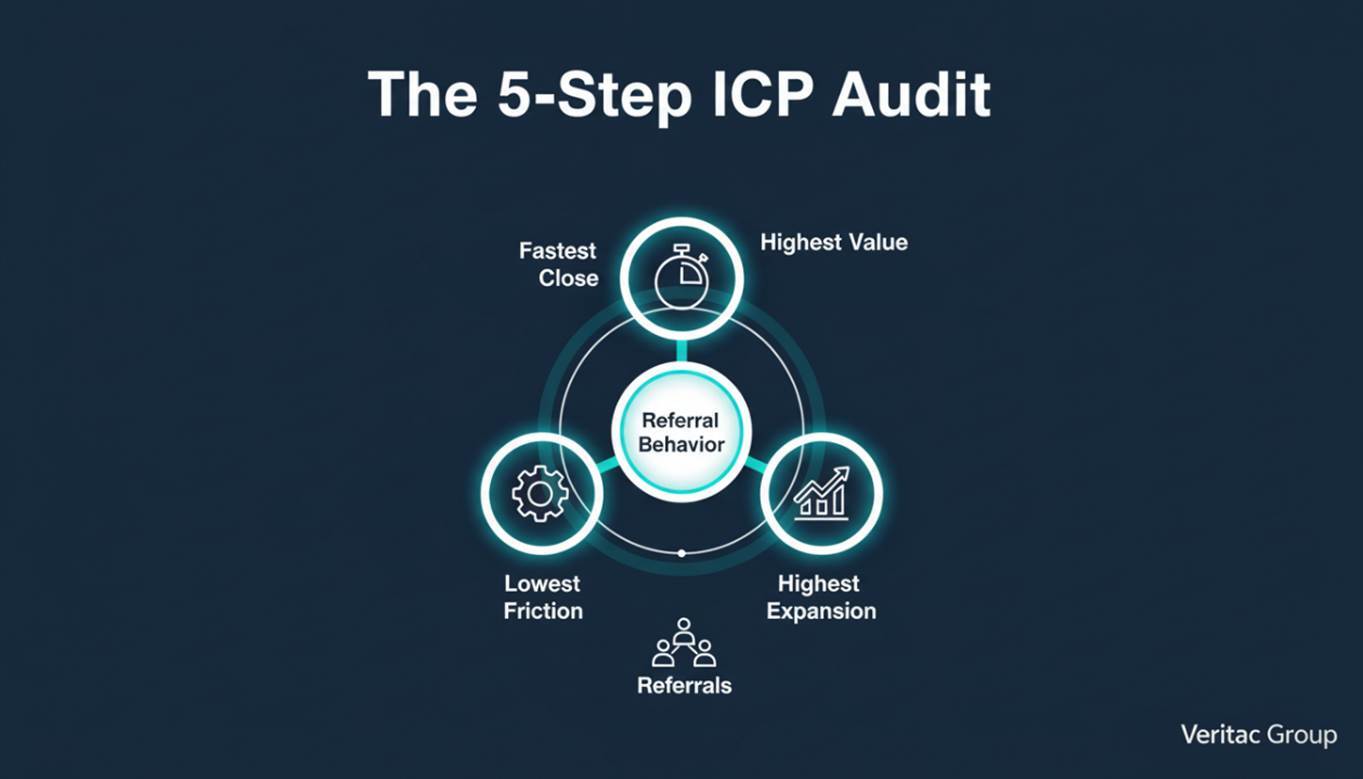
Most companies describe their ideal customer profile in terms of demographics: industry, company size, job titles, and geography. This is a targeting profile, not an ICP. A conversion-focused ICP answers a different question: which accounts actually generate the outcomes we want?
The distinction matters because many companies acquire customers who look right but behave wrong, This means long sales cycles, implementation friction, low expansion, high churn. These customers consume resources without generating compounding returns.
The audit process:
Pull your last twenty closed deals and score each one across five dimensions:
- Time to close: Which deals moved fastest through the pipeline?
- Contract value: Which generated the highest ACV or lifetime value?
- Implementation friction: Which onboarded smoothly and reached value quickly?
- Expansion rate: Which accounts grew their spend over time?
- Referral behavior: Which customers actively referred new business?
The insight comes from the overlap. If your fastest deals are also your highest-value, lowest-friction, highest-expansion accounts, your ICP is aligned. If those groups diverge, fast deals that churn, high-ACV deals that never expand, smooth implementations that came from low-value segments, your targeting is diluted.
Diluted targeting creates a compounding drag on growth. Marketing spends budget reaching accounts that will never convert efficiently. Sales invests cycles in deals that close but churn. Customer success inherits accounts that were never a fit. Every function works harder to compensate for upstream misalignment.
The fix is focus. Narrow the aperture to the accounts that cluster across multiple success criteria, then align messaging, qualification, and go-to-market resources around that profile.
Framework 2: The Pipeline Quality Scorecard
Pipeline coverage ratios are the most commonly cited metric in sales reviews and the least useful for predicting outcomes. A 4x pipeline that is 80% low-quality deals will underperform a 2x pipeline of well-qualified opportunities.
The problem is that CRM stages reflect seller activity, not buyer commitment. An opportunity marked "proposal sent" tells you what the rep did, not whether the deal will close. Pipeline quality scoring shifts the lens from seller actions to buyer signals. fullcast.com
The scoring model:
For each active opportunity, assign a score from 1 to 5 on five dimensions:
- Economic buyer identified: Is the person who controls budget engaged, or are you working through an influencer who cannot approve spend?
- Budget confirmed: Has the prospect explicitly confirmed funding availability, or is budget assumed?
- Clear use case: Does the prospect have a defined problem and a vision for how your solution addresses it?
- Defined timeline: Is there a date by which a decision must be made, or is the project open-ended?
- Compelling event: What external pressure creates urgency? A regulatory deadline, a contract expiration, a strategic initiative with board visibility?
Sum the scores. A deal scoring below 15 is at risk; it may close eventually, but it is not forecastable. Deals between 15 and 20 represent real opportunities with committed buyers. Deals above 20 are high-confidence, near-term closers.
Most companies discover that the majority of their forecasted pipeline scores below 15. This is not a revelation about individual deals; it is a diagnosis of systemic qualification weakness. Reps are advancing opportunities that lack the buyer conditions necessary for a decision.
The remedy is not to disqualify deals aggressively; it is to use the score to direct effort. Low-scoring deals need development: identify the economic buyer, surface the compelling event, confirm budget. High-scoring deals need acceleration: remove friction, mobilize resources, close.
Framework 3: The Funnel Efficiency Framework
Before adding budget, measure conversion. This principle sounds obvious, but it is routinely violated. Companies with stalled growth often respond by increasing top-of-funnel investment, more demand gen, more SDRs, more content, without understanding where leads actually leak out of the system.
The diagnostic:
Calculate three ratios from the last two quarters:
- MQL → SQL conversion: What percentage of marketing-qualified leads convert to sales-qualified opportunities?
- SQL → Closed-Won conversion: What percentage of qualified opportunities convert to revenue?
- Average sales cycle: How long does it take to move from first meeting to signed contract?
Then ask: where is the biggest drop?
If MQL → SQL conversion is weak, the problem is likely qualification criteria or lead quality. Marketing and sales are not aligned on what "qualified" means, or the leads being generated do not match the ICP.
If SQL → Closed-Won conversion is weak, the problem is in the sales process itself. Deals are being qualified but not closed. Common causes include weak discovery, missing proof points, poor objection handling, or misalignment between what was sold and what the prospect actually needs.
If the sales cycle is lengthening, deals are stalling. Look for patterns: at which stage do deals slow down? What objections or missing information creates friction?
The insight here is directional. Growth is not a top-of-funnel problem by default; it is a constraint removal problem. The highest-leverage investment is whatever unblocks the tightest constraint in the system. Adding more leads to a leaky funnel just creates more waste.
Framework 4: The "Why We Win" Framework
Positioning is not what you say about yourself. Positioning is the story your customers tell about why they chose you. When those two narratives diverge, marketing scales the wrong message and sales fights uphill against misaligned expectations.
The audit process:
Conduct structured reviews of your last ten wins. For each deal, answer three questions:
- Why did they buy? What problem were they trying to solve, and why did solving it become urgent?
- Why you versus alternatives? What differentiated your solution in the buyer's mind? This includes competitors, internal builds, and doing nothing.
- What almost killed the deal? Where did the buyer hesitate, and what resolved their concern?
The patterns that emerge from this review are your actual positioning, the reasons buyers choose you in practice, not in theory.
Compare these patterns to your current messaging. If the website emphasizes features that buyers did not mention, or ignores the differentiators that actually mattered, the messaging needs realignment.
This exercise is particularly valuable after leadership changes, new product releases, or market shifts. Positioning drift happens gradually; win reviews surface it explicitly.
Framework 5: The 30-60-90 Pipeline Test
Forecast accuracy is a proxy for pipeline visibility. If leadership cannot articulate what is closing in the next 30, 60, and 90 days with specificity, the pipeline is not being managed, it is being observed.
The test:
Ask your sales leader three questions:
- What is closing in the next 30 days?
- What is closing in the next 60 days?
- What is closing in the next 90 days?
The answers should include specific account names, deal values, expected close dates, and the buyer actions required to close. If the answers are vague, "we have a few things working," "pipeline is building," "depends on a couple of big deals," visibility is weak.
Weak visibility has two root causes. Either the deals themselves are poorly qualified (see Framework 2), or the pipeline review process is not rigorous enough to surface the truth.
The 30-60-90 test is a forcing function. It requires reps to commit to specific outcomes on specific timelines, which creates accountability and surfaces deals that are not as far along as they appeared.
Predictability matters because it enables resource allocation. If you know what is closing, you can plan hiring, capacity, and investment. If you are guessing, you are reacting.
Framework 6: The Retention Risk Diagnostic
Churn is usually treated as a customer success problem. But early churn, customers who leave within the first year, is almost always an upstream problem. The issue is not post-sale delivery; it is what was sold and to whom.
The diagnostic:
Segment churned customers across three dimensions:
- Time to churn: How long did customers stay before leaving? Cluster them into cohorts: 0–3 months, 3–6 months, 6–12 months, 12+ months.
- Original use case: What problem did the customer believe they were solving? Does that match what your product actually does well?
- Sales versus delivered value: What was promised in the sales process, and what was actually delivered?
If churn clusters early, customers leaving within the first six months, the issue is upstream. Either the wrong customers are being acquired, or the sales process is setting expectations the product cannot meet.
If churn clusters later, the issue is more likely product-market fit erosion, competitive displacement, or customer success execution.
The remedy depends on the diagnosis. Early churn requires tighter qualification, clearer expectation-setting, and better alignment between sales messaging and product capability. Later churn requires product investment, competitive positioning, or customer success process improvement.
Retention is a growth lever because it affects the denominator. Reducing churn by 10% often has more impact on net revenue retention than increasing new bookings by 10%, and it requires less capital to achieve.
Framework 7: The Messaging Clarity Test
Messaging fragmentation is one of the most common and least visible growth constraints. It happens gradually: different teams develop their own language, new hires improvise, product releases add complexity. Over time, the company loses a coherent answer to the most basic question: what problem do we solve, and for whom? salesfundas.com
The test:
Ask five internal stakeholders: sales, marketing, product, customer success, executive leadership to answer one question without preparation: "What problem do we solve, for whom?"
Then ask five customers the same question.
If the answers differ significantly, across internal teams or between internal and external perspectives, messaging is fragmented.
Fragmented messaging creates friction at every stage of the funnel. Marketing attracts the wrong leads. Sales struggles to articulate value. Customers arrive with misaligned expectations. Everyone works harder to compensate for the lack of a shared narrative.
The fix is alignment, not wordsmithing. Messaging clarity comes from agreement on the core value proposition, not from better taglines. The exercise of surfacing fragmentation often matters more than the messaging document that follows.
Framework 8: The Expansion Revenue Check
Net revenue retention is the metric that separates good SaaS companies from great ones. A company with 120% NRR can grow 20% annually with zero new customer acquisition. A company with 90% NRR must acquire 30% new revenue just to grow 20%.
Expansion revenue, i.e., upsells, cross-sells, and seat expansion within existing accounts, is the primary driver of NRR. Yet many mid-market companies treat expansion as an afterthought.
The diagnostic:
Answer three questions:
- What percentage of revenue comes from existing customers? This should be tracked monthly and trended over time.
- Is there a defined upsell motion? Do account managers have a playbook for identifying and executing expansion opportunities, or does it happen ad hoc?
- Are incentives aligned? Are sales and customer success compensated on expansion, or only on new bookings?
If expansion is inconsistent, the issue is usually structural. Either there is no defined process for identifying expansion opportunities, or the incentives do not reward it.
Your existing customer base is your most efficient growth channel. They already trust you, they already understand the product, and they already have budget allocated. A systematic expansion motion often generates 3–5x the ROI of new customer acquisition.
Framework 9: The Sales Cycle Friction Audit
Stalled deals are information. They reveal where the sales process breaks down, which objections are not being handled, and which proof points are missing.
The audit process:
Review your last five stalled deals, opportunities that were qualified and advancing but then stopped moving. For each, answer three questions:
- Where did the deal slow down? At which stage did momentum stop? After discovery? After demo? After proposal?
- What objections surfaced? What concerns did the buyer raise that were not resolved?
- What proof was missing? What evidence did the buyer need that you could not provide?
Patterns in the answers reveal systemic friction points. If deals consistently stall after demo, the demo is not connecting to buyer priorities. If objections cluster around implementation risk, case studies and references are missing. If deals stall at procurement, legal and security documentation needs improvement.
These friction points are growth levers. Removing one friction point can accelerate cycle time across the entire pipeline, which compounds into faster revenue realization and better capital efficiency.
Framework 10: The Scalability Test
Before adding spend, test readiness. Scaling is not about growth rate; it is about whether growth is replicable and predictable.
The test:
Answer three questions honestly:
- Can new reps replicate success? If you hire a new salesperson tomorrow, can they achieve productivity within a defined ramp period using existing playbooks, or does success depend on tribal knowledge and individual heroics?
- Can you forecast within 10–15% accuracy? Over the last four quarters, how close have your forecasts been to actual results? If variance exceeds 15%, the pipeline is not predictable enough to scale. salesfully.com
- Do you know which channels drive revenue? Can you attribute closed revenue to specific marketing channels and campaigns with confidence?
If any answer is no, scaling amplifies inefficiency. Adding budget to unpredictable systems creates unpredictable outcomes. Adding headcount to undocumented processes creates inconsistent execution.
The scalability test is not a gate; it is a diagnostic. The goal is not to delay growth until everything is perfect. The goal is to understand which systems need investment before scale, and which can be refined in parallel with growth.
The Compound Effect of Diagnostic Discipline
Each of these frameworks addresses a specific failure mode. But the real value comes from running them together, because the failure modes interact.
A weak ICP creates pipeline quality problems. Pipeline quality problems create forecast inaccuracy. Forecast inaccuracy creates resource misallocation. Resource misallocation creates sales cycle friction. Sales cycle friction creates churn. Churn destroys expansion revenue. And the cycle continues.
The reverse is also true. A sharp ICP improves pipeline quality. Better pipeline quality improves forecast accuracy. Accurate forecasts enable better resource allocation. Better resources reduce friction. Less friction improves retention. Better retention enables expansion. And growth compounds.
Diagnosis is not a one-time exercise. The highest-performing mid-market companies run these audits quarterly, treating revenue systems with the same rigor they apply to financial controls. The cost of diagnosis is hours; the cost of scaling the wrong things is years.
Clarity First, Growth Follows
The frameworks in this playbook share a common assumption: that growth is a systems problem, not a heroics problem. The companies that scale efficiently are not necessarily the ones with the best products or the most charismatic founders. They are the ones with the clearest understanding of how their revenue engine works, and where it breaks.
Mid-market growth is hard because the margin for error is small. You cannot outspend mistakes. You cannot pivot fast enough to recover from fundamental misalignment. The only reliable path is to see clearly, act precisely, and invest where the evidence points.
That discipline, diagnosing before investing, measuring before scaling, focusing before expanding, is what separates companies that grow from companies that grow efficiently.
Veritac Group partners with mid-market companies and private equity firms to unlock growth through an integrated go-to-market strategy, execution, and optimization. The APRO™ Framework has been deployed across dozens of portfolio companies to drive measurable revenue acceleration and exit multiple expansions.