#PrivateEquity #GrowthStage
Learn how mid-market and PE-backed SaaS companies can eliminate revenue leakage and transform RevOps for scalable, predictable growth and improved EBITDA.
Executive Summary
Mid-market and private equity–backed SaaS companies face an increasingly unforgiving growth environment. Expectations for ARR expansion, EBITDA improvement, and forecast predictability have intensified over the past five years as investors demand disciplined execution and faster value creation. Yet even in well-managed organizations, 5–15% of annual revenue is lost to operational leakage, according to Bain & Company’s “Revenue Leakage in Software,” 2023. These losses often stem from fragmented processes, inconsistent definitions, outdated systems, or disconnected teams.
Such issues are rarely obvious day-to-day. But over a 12–36-month value-creation cycle, they quietly compound—slowing growth, weakening margins, and damaging exit valuations.
This white paper outlines a practical, data-supported approach for CEOs, operators, and GTM leaders to eliminate revenue leakage and transform RevOps into a strategic engine for scalable, predictable, EBITDA-accretive growth. It integrates research from Bain, McKinsey, Gartner, TSIA, KeyBanc, Forrester, and RevOps Co-Op, while providing actionable frameworks, charts, and examples tailored specifically to mid-market and PE-backed SaaS companies.
Eliminating revenue leakage, improving predictability, and enabling AI-driven automation all depend on a unified, well-designed GTM operating system.
Introduction: Why Revenue Leakage Threatens Growth
As SaaS companies move from product-led early growth into mid-market scale—typically between $15M and $80M ARR—they often encounter a structural problem: the business has outgrown the operating model that originally got it here.
Founder-driven processes, informal workflows, inconsistent CRM usage, and patchwork tools may work adequately at $5M or $10M ARR. But at scale—and especially under the scrutiny of private equity sponsors—they become liabilities that create unpredictability and hidden costs.
Private-equity backed organizations face an even more complex challenge. Investor expectations require:
- Faster repeatability in pipeline creation
- More rigorous forecasting with increased predictability
- Clear GTM accountability across sales, marketing, and customer success
- Margin expansion, not simply top-line growth
- Integration discipline when acquisitions are involved
The shift from “grow fast” to “grow predictably and profitably” exposes operational cracks.
This transition is precisely where Revenue Operations (RevOps) plays a transformative role. RevOps provides the unifying framework needed to eliminate friction, simplify systems, strengthen forecasting, and reduce cost—turning revenue leakage into EBITDA lift.
Section 1: Understanding Revenue Leakage in SaaS
Revenue leakage describes the cumulative impact of inefficiencies across the customer lifecycle that prevent a company from capturing the full value it should. Leakage is not usually the result of one large failure. Instead, it is the aggregation of multiple small breakdowns—none are catastrophic alone, but collectively they are destructive.
These breakdowns occur in both early- and late-stage revenue processes. For example:
- A poorly defined MQL handoff leads to slow or missed follow-up.
- A rep offers unauthorized discounts because pricing governance is unclear.
- A renewal date isn’t logged correctly, resulting in last-minute fire drills.
- Customer usage signals are not surfaced, so expansion opportunities go unnoticed.
Over time, these inefficiencies quietly erode ARR, margins, and NRR.
Common Leakage Categories
| Leakage Category | Example | Impact |
| Leads | Unworked MQL | 10 - 20% pipeline loss |
| Pricing | Excess discounting | 5 - 15% margin erosion |
| Renewals | Poor renewal discipline | 3 - 8 points GRR loss |
| Expansion | Missed upsells | 10 - 40% upsell missed |
Estimates from Bain, Forrester, Gartner, TSIA, and KeyBanc
These categories often overlap. For instance, pricing inconsistency may stem from poor sales governance, which itself is related to inaccurate CRM data—both of which feed forecast variance.
Why Leakage Hits Mid-Market & PE-Backed Companies Hardest
- Inherited GTM Debt:
Founder-era processes often lack documentation, discipline, or consistency. - Add-On Acquisitions:
Multiple CRMs, separate product lines, and fragmented data create structural friction. - Limited RevOps Investment:
Many mid-market teams rely on a single operations generalist expected to support multiple departments. - PE Expectations:
Boards require accurate forecasting, clear attribution, and measurable ROI.
These dynamics make leakage not only more likely but also more damaging.
Section 2: How RevOps Expands EBITDA
- Reducing Customer Acquisition Cost (CAC)
Through Operational Efficiency
RevOps reduces CAC by improving the speed, accuracy, and efficiency of how leads move through the funnel. When workflows are standardized and supported by automation, GTM teams waste less time, convert more efficiently, and spend less to acquire each customer.
RevOps reduces CAC by:
- Streamlining lead routing to ensure faster follow-up and higher conversion.
- Improving channel attribution to eliminate spend on underperforming sources.
- Automating manual sales tasks to increase rep productivity and active selling time.
Lower CAC directly improves EBITDA by reducing the cost structure required to generate pipeline and new ARR.
- Increasing Annual Contract Value (ACV)
Through Pricing and Packaging Governance
RevOps increases ACV by bringing discipline and consistency to how deals are structured, priced, and approved. With clear rules and tighter governance, companies capture more value per customer and reduce margin erosion caused by inconsistent discounting.
RevOps increases ACV by:
- Standardizing discount thresholds to prevent unnecessary margin loss.
- Introducing packaging and paywall structures that encourage higher-value tiers.
- Implementing deal-desk workflows that improve pricing decisions and deal quality.
Higher ACV expands EBITDA by improving gross margin and increasing revenue efficiency per deal.
- Strengthening Net Revenue Retention (NRR) and Gross Revenue Retention (GRR) Through Lifecycle Management
RevOps improves retention by formalizing renewal, expansion, and customer-health workflows. With consistent lifecycle management, companies identify risks earlier, expand accounts more systematically, and prevent customer erosion.
RevOps improves retention by:
- Maintaining accurate renewal data and proactive renewal workflows.
- Building expansion triggers that are grounded in usage signals and customer behavior.
- Standardizing handoffs, health scoring, and Customer Success processes for greater consistency.
Improved NRR and GRR predictably lift EBITDA by increasing the lifetime value of each customer and reducing churn volatility.
- Lowering Operating Expenses (OPEX)
Through Tech Stack Consolidation
RevOps lowers OPEX by rationalizing the GTM technology ecosystem and eliminating redundant or low-value tools. A streamlined stack reduces waste, improves adoption, and creates a more efficient operating environment across Sales, Marketing, and Customer Success.
RevOps reduces OPEX by:
- Identifying overlapping systems acquired over time by multiple teams.
- Consolidating platforms to reduce licensing, integration, and maintenance costs.
- Increasing adoption of core tools through standardized processes and workflows.
Reducing OPEX delivers immediate EBITDA improvement through lower operational spend and higher team productivity.
- Improving Forecast Accuracy Through
Process Standardization and Intelligent Insights
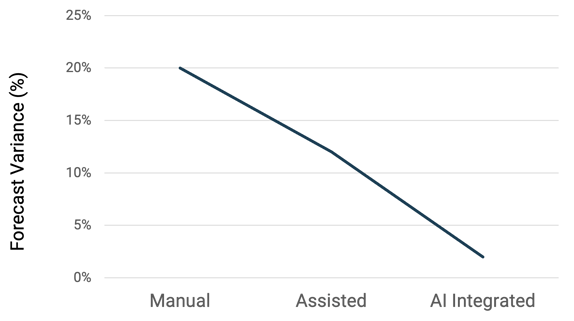
RevOps improves forecasting by unifying definitions, tightening pipeline discipline, and infusing analytics into deal reviews. With consistent processes and AI-supported insight, forecasts become more reliable and variance decreases significantly.
RevOps improves forecast accuracy by:
- Defining standardized sales stages with clear, objective exit criteria.
- Aligning all GTM functions to a single pipeline taxonomy and qualification model.
- Implementing automated deal-health scoring and AI-driven forecast analysis.
Greater forecast accuracy strengthens EBITDA by enabling tighter planning, better resource allocation, and increased investor confidence.
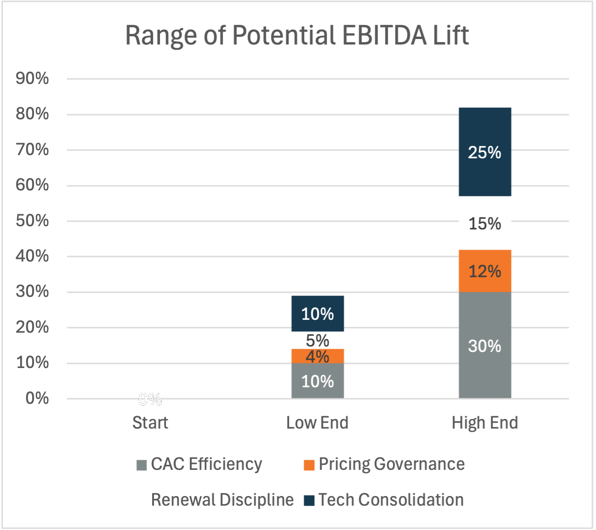
Key EBITDA-Accretive Levers
| Lever | Metric Improved | Typical LIft |
| CAC Efficiency | CAC⇩ | 10 - 30% |
| Pricing Governance | ACV ⇧ | 4 - 12% |
| Renewal Discipline | GRR/NRR ⇧ | +5 – 15 pts |
| Tech Consolidation | OPEX⇩ | 10 – 25% |
| Forecast Accuracy | Variance⇩ | 20 – 40% |
These improvements, especially when combined, create a compounding effect that materially expands EBITDA. For example, improving NRR by even 5 points often contributes more EBITDA lift than doubling net-new logo activity—yet many companies overlook this significant impact because their data and systems obscure lifecycle insights.
Estimated EBITDA Lift from RevOps
Section 3: Why CEOs Must Lead RevOps Transformation
RevOps touches every department that influences revenue. For this reason, it cannot be owned solely by operations teams, systems admins, or departmental managers. Without CEO sponsorship, RevOps becomes fragmented or ignored—precisely the opposite of its intended purpose.
CEO leadership matters because:
- Alignment Requires Authority
Most revenue leakage stems from misalignment—different teams using different definitions, priorities, and systems. Most often, it’s only the CEO who can mandate unified GTM governance.
- Incentives Must Be Reset
Sales, Customer Success, and Marketing often operate on conflicting metrics. RevOps aligns their KPIs around holistic revenue outcomes.
- PE Boards Expect Predictability
Boards rely on forecast accuracy and data consistency. The CEO ensures that RevOps has the mandate to deliver it.
- Investment Decisions Must Prioritize Long-Term Value
CEOs must hire RevOps leaders with experience in mid-market scale-ups, or PE, not simply CRM administrators.
As McKinsey’s 2024 “GTM Leadership in SaaS” states:
“RevOps succeeds or fails based on executive sponsorship—not tooling.”
Section 4: APRO: The RevOps Transformation Framework
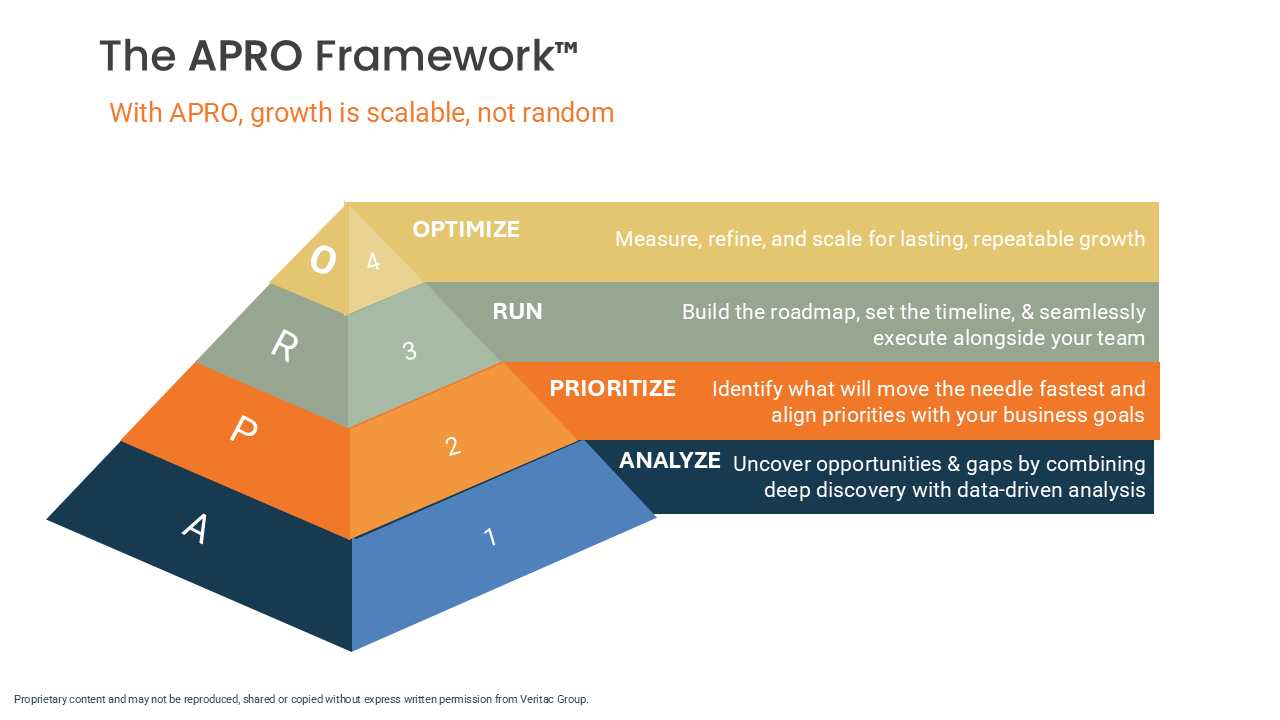
RevOps transformation follows a predictable four-stage pattern:
Each phase builds on the next, reducing operational friction and aligning the revenue engine.
Source: Veritac Group Proprietary
Step 1: Analyze (0-30 Days)
This phase uncovers the real sources of leakage.
Typical activities include:
- Data integrity audit
- CRM architecture review
- Customer journey mapping
- Forecast process assessment
- Tech stack overlap analysis
- Pricing and discounting policy evaluation
Most companies discover inconsistencies they had no idea existed—such as hundreds of duplicate accounts, multi-stage pipeline definitions, or inaccurate renewal dates.
Step 2: Prioritize (30-60 Days)
This phase establishes the blueprint for a scalable GTM engine:
- Unified sales stages
- Funnel definitions
- Forecast categories
- Deal desk rules
- Naming conventions
- SLAs between teams
This stage also establishes the foundations necessary for AI to add value.
Step 3: Run (60–120 Days)
Deployment brings the blueprint to life:
- CRM re-architecture
- Workflow automation
- Dashboard creation
- Sequence and campaign automation
- Tech consolidation
The result is faster execution and more accurate insights.
Step 4: Optimize (Ongoing)
RevOps matures through continuous improvement:
- Quarterly workflow reviews
- Additional automation
- AI model enhancement
- SLA refinement
- Expansion playbook rollout
This final stage turns RevOps into a long-term operating system.
Section 5: The RevOps Metrics Model & Common Pitfalls
RevOps standardizes performance measurement across the GTM motion.
Metrics Hierarchy
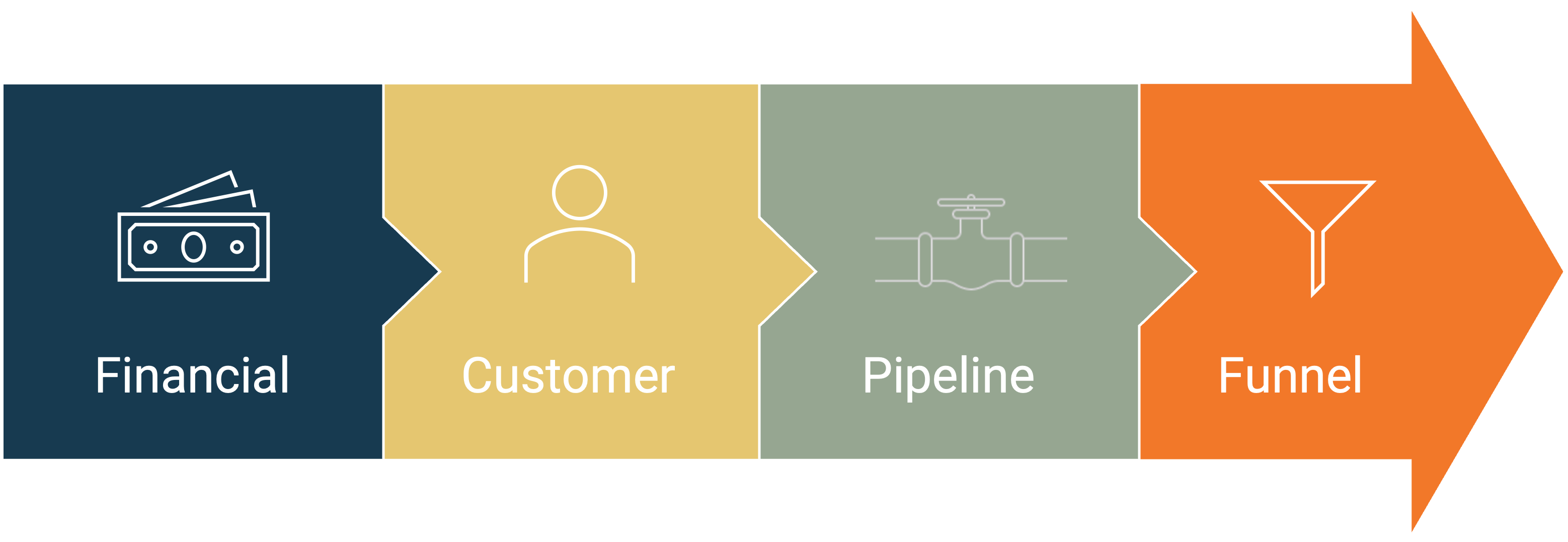
This hierarchy ensures leading indicators (funnel and pipeline) align with lagging indicators (revenue and retention).
PE-Ready KPI Snapshot
| Category | KPIs | Target Benchmarks |
| Funnel | MQL - SQL | 15 - 25% |
| Pipeline | Win Rate | 20 - 35% |
| Forecasting | AccuracyGRR | + 5 - 8% |
| Customer | GRR | 85 - 95% |
| Customer | NRR | 110 - 130% |
| Finance | CAC Payback | < 18 months |
Common Pitfalls
Even well-funded mid-market and PE-backed SaaS companies struggle to realize the full value of RevOps when foundational elements are misaligned. The most common pitfalls include:
- Automating Broken Processes
Many companies attempt to solve operational challenges by adding automation before the underlying workflows are defined, documented, or validated. This accelerates inefficiency rather than eliminating it. When automation is layered on top of inconsistent lead routing, unclear sales stages, or ad-hoc renewal processes, errors become systemic—and dramatically harder to unwind. - “Tool-First” Instead of “Process-First” Thinking
A frequent misconception is that RevOps is primarily a software problem. As a result, teams invest in new tools hoping they will fix structural GTM issues. In reality, technology should enable processes—not define them. Buying tools before defining the operating model leads to bloated tech stacks, low adoption, and fragmented data. In PE-backed companies, this increases OPEX and creates confusion across GTM teams. - Incentive Misalignment Across Sales, CS, and Marketing
Revenue leakage often stems from teams working toward different goals. When Marketing optimizes for volume, Sales for bookings, and CS for satisfaction—without shared revenue targets—the organization’s efforts diverge. Misaligned incentives produce pipeline inflation, discount-driven selling, poor handoffs, and churn that could have been prevented with shared KPIs such as NRR, ACV, or CAC efficiency. - Poor Data Hygiene
Data quality issues—duplicate records, inconsistent fields, incomplete entries, or outdated account information—undermine every aspect of RevOps.
Poor data hygiene compromises forecasting, reduces conversion rates, weakens customer insights, and limits the effectiveness of AI-based predictions. Without disciplined governance, GTM data becomes unreliable and non-actionable.
- Integration Gaps Post-Acquisition
Add-on acquisitions are common in mid-market and PE portfolios, but integrating GTM systems and processes is often deprioritized. Disconnected CRMs, siloed product usage data, and inconsistent reporting frameworks create structural blind spots. These gaps directly slow cross-sell, distort forecasting, and create hidden churn risks that only surface at renewal.
Why These Pitfalls Matter
Each of these failures—whether process, system, or alignment-related—directly contributes to:
- Forecast volatility
- Pipeline inefficiency
- Customer churn and missed expansion
- Higher CAC and operational waste
- Reduced EBITDA and lower enterprise value
Addressing these pitfalls early is one of the fastest ways to increase predictability, reduce leakage, and accelerate RevOps impact.
Section 6: The Expanding Role of AI in RevOps
AI is rapidly transforming RevOps, but only organizations with strong processes, clean data, and unified architecture can benefit. Those with inconsistent workflows or bad data often find that AI scales the wrong outputs faster.
Strategic AI Use Cases in Go-to-Market
- Predictive lead scoring
- Churn prediction 90–120 days in advance
- Automated forecast modeling
- Deal-health indicators from conversation intelligence
- AI-assisted pricing and discounting
- Product usage–based expansion modeling
Critical Principle
As RevOps Co-Op’s “AI in Revenue Operations Report,” 2024 notes:
“AI doesn’t fix GTM problems; it scales them.”
Organizations must get the fundamentals right before introducing automation.
Forecast Accuracy by AI Maturity
Section 7: Translating RevOps into EBITDA Gains
RevOps is not an efficiency project—it is a value-creation strategy.
Quick Wins (0–60 Days)
These actions produce immediate measurable impact, reduce leakage fast, and build confidence with investors and internal teams.
- Fix lead routing
Establish clear rules for speed-to-lead, ownership, and follow-up, ensuring no MQL or SQL is lost due to gaps in handoffs or workflow confusion. This typically increases pipeline conversion within weeks.
- Introduce discount guardrails
Implement standardized discount thresholds, approval paths, and deal desk oversight to prevent inconsistent pricing and margin erosion—one of the biggest hidden drains on EBITDA.
- Create a renewal operating cadence
Define renewal stages, responsibilities, timelines, and forecasting intervals so teams proactively manage churn risk instead of reacting to it late in the cycle.
- Consolidate redundant GTM tools
Identify underutilized platforms, duplicate licenses, or point solutions that overlap. Eliminating even a few tools can reduce OPEX by 10–25% and improve adoption of core systems.
Long-Term Drivers (60–180+ Days)
These initiatives build durable, scalable revenue infrastructure and position the company for predictable, profitable growth.
- Unified GTM operating model
Design a shared framework across Marketing, Sales, and CS—including definitions, processes, handoffs, and reporting—so the entire revenue engine operates as one cohesive system.
- End-to-end lifecycle governance
Establish governance for pipeline integrity, customer health scoring, expansion workflows, renewal management, and post-sale engagement to minimize leakage across every lifecycle stage.
- AI-enabled forecasting
Enhance forecast accuracy by incorporating AI-generated deal scoring, activity intelligence, anomaly detection, and predictive modeling. This reduces variance, increases confidence, and improves resource planning.
- Multi-product expansion playbooks
Create structured pathways for cross-sell and upsell across product lines—leveraging usage insights, ICP heuristics, and customer journey triggers—to systematically improve NRR and customer lifetime value.
Why These Matter
Together, these quick wins and long-term drivers create the conditions for:
- Lower CAC
- Higher ACV
- Improved NRR and GRR
- More predictable performance
- Stronger EBITDA contribution
- Higher enterprise value
They represent the practical roadmap by which RevOps becomes a true value-creation engine.
Conclusion
For mid-market and PE-backed SaaS companies, RevOps is now a strategic necessity—not a technical enhancement. Eliminating revenue leakage, improving predictability, and enabling AI-driven automation all depend on a unified, well-designed GTM operating system.
The companies that embrace RevOps as a strategic discipline consistently outperform peers in growth, profitability, and valuation.
“Companies with strong RevOps alignment
grow 12–15% faster and are 34% more profitable.”
(McKinsey, “GTM Performance Benchmarking,” 2023)
About the Author
David Garcia, Managing Partner with Veritac Group brings over 25 years of Go-To-Market (GTM) strategy and execution across SaaS, healthcare, and financial services. He partners with investors and CEOs to accelerate top-line growth and drive strategic exits. He has helped numerous portfolio companies scale, working with firms like Thoma Bravo and The Riverside Company.